

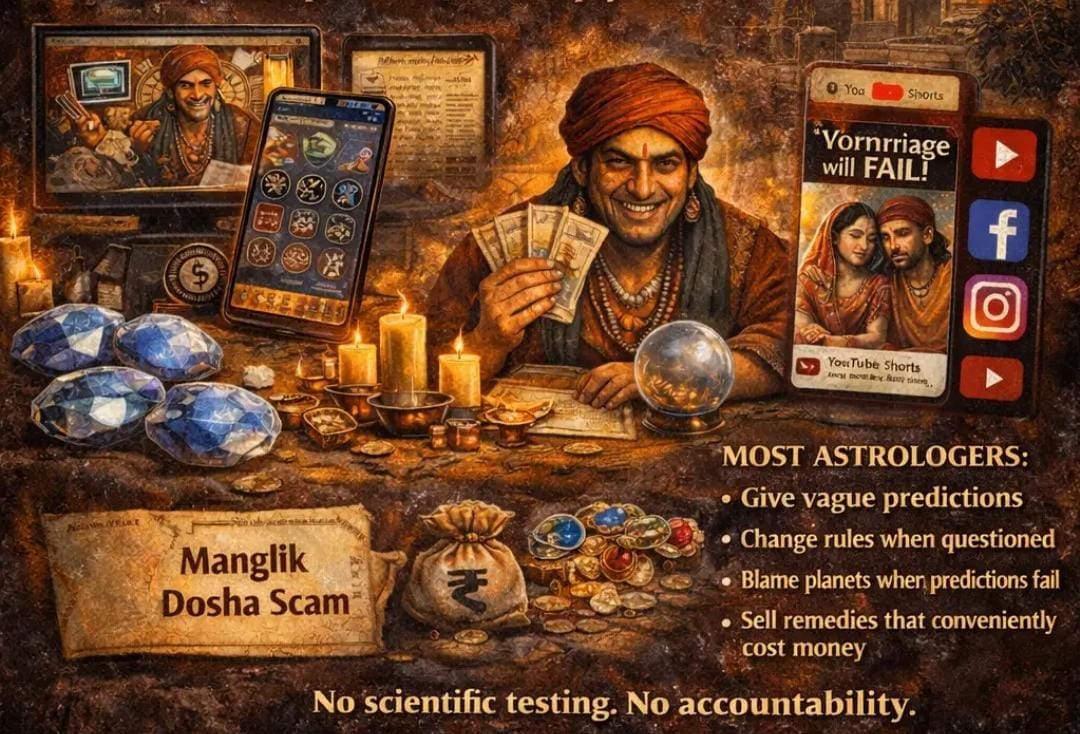
The First Thing to Understand: Astrology in India Did Not Start the Way It Exists Today
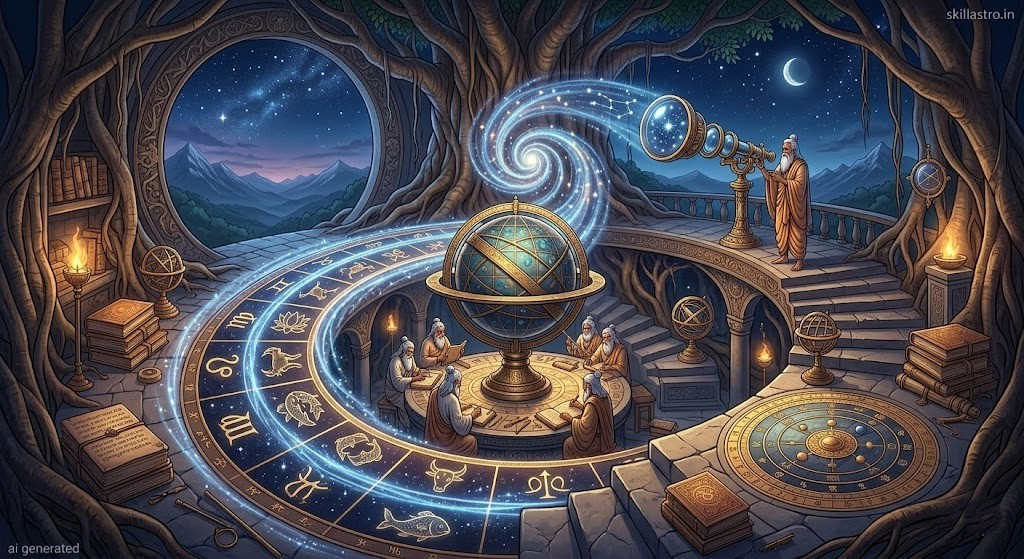
To understand astrology in India, the first step is to remove a common misunderstanding. What exists today is not what existed thousands of years ago.
In early Indian knowledge systems, the study of the sky was primarily practical. People observed the Sun, Moon, and stars to understand seasons, measure time, and organize agricultural cycles. This system was called Jyotisha, and it was closely linked to mathematics and observation.
Scholars like Aryabhata made precise calculations about planetary motion and eclipses. Their work was based on logic and numbers, not on predicting individual human destiny.
There is no strong evidence that early Indian astronomy operated as a system that claimed planets directly controlled personal life outcomes in the way modern astrology does.
This distinction is important. Because what we call astrology today is not a direct continuation of that early scientific approach.
The Shift: When Predictive Astrology Entered and Mixed With Existing Systems
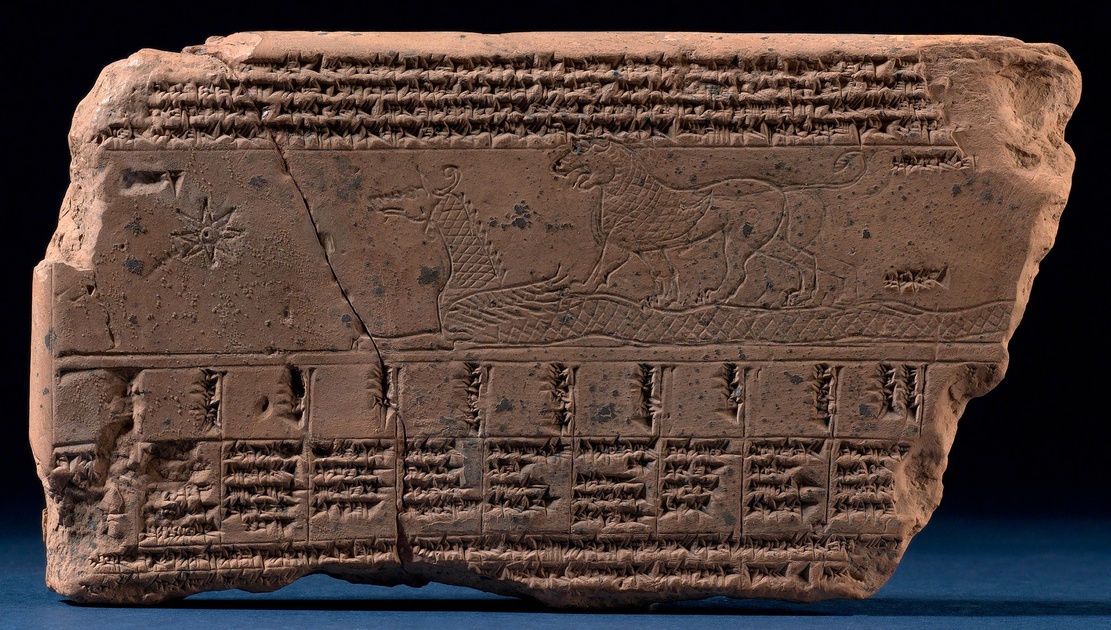
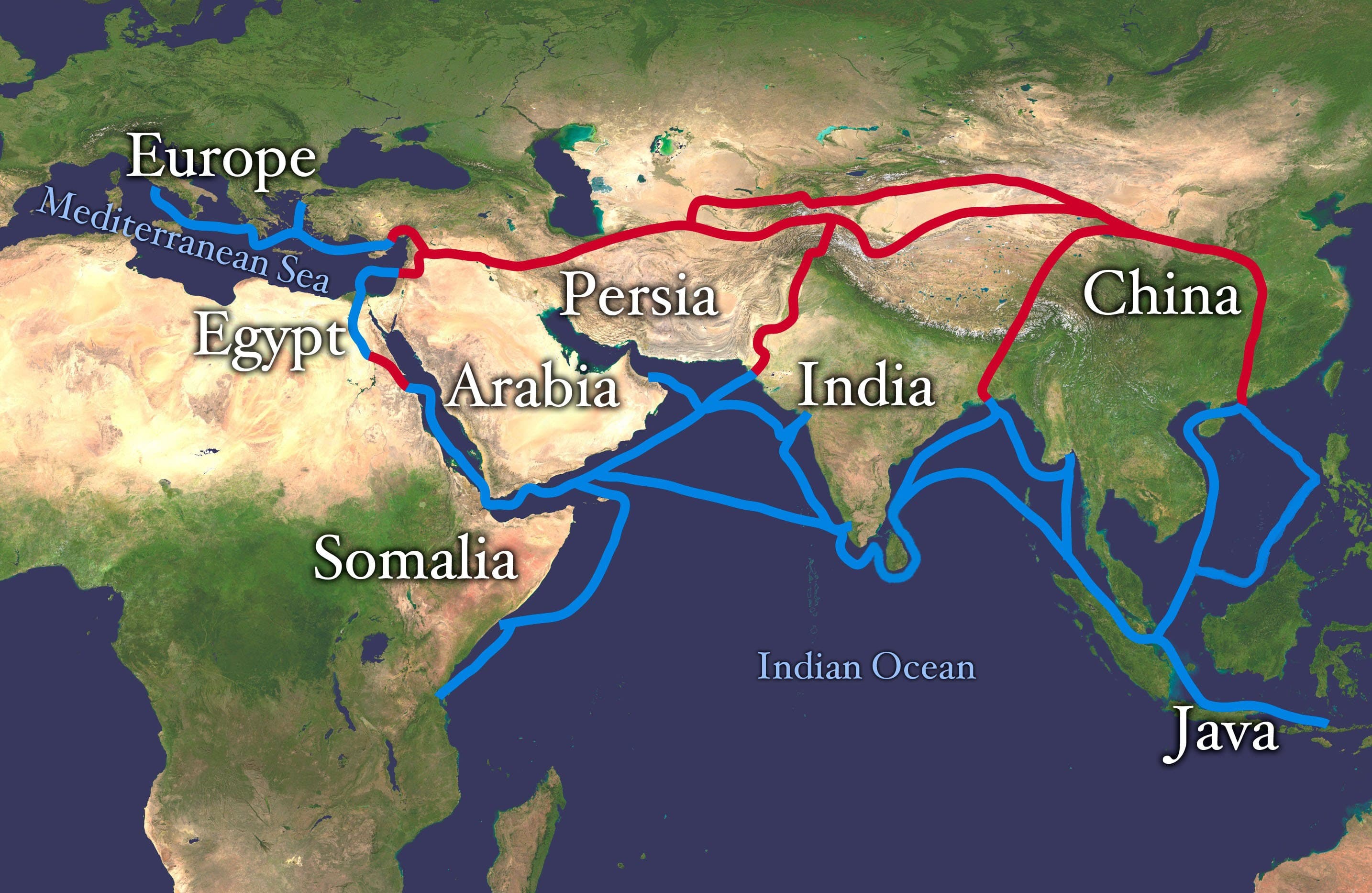
Historical research suggests that predictive astrology, especially horoscope-based systems, developed through a mix of influences.
Greek and Babylonian traditions already had systems where planetary positions were linked to human fate. During periods of cultural exchange, especially after Alexander’s contact with the Indian subcontinent, these ideas interacted with existing Indian knowledge systems.
Texts were translated, adapted, and reinterpreted. Over time, elements of predictive astrology became part of Indian intellectual traditions.
This does not mean astrology was “imported fully” or “purely indigenous.” The more accurate view is that it evolved through a combination of local and external influences.
As centuries passed, these ideas became more structured and widely practiced.
The Real Turning Point: When Astrology Gained Social and Religious Authority

The major transformation did not happen at the point of origin. It happened during social change.
During the medieval period, access to scientific education reduced among common people. At the same time, uncertainty increased due to political instability, economic shifts, and health risks.
Astrology provided answers.
It offered explanations for uncertainty. It gave a sense of control in situations where people had very little control.
Gradually, astrology became associated with religious and cultural practices. Once something is framed in a religious or traditional context, people become less likely to question it.
This is where belief became stronger than verification.
Practices such as dosha systems, ritual remedies, and gemstone prescriptions expanded significantly during later periods. These practices are not uniformly found in early philosophical texts but became part of social tradition over time.
Modern Astrology: From Cultural Practice to Commercial Industry
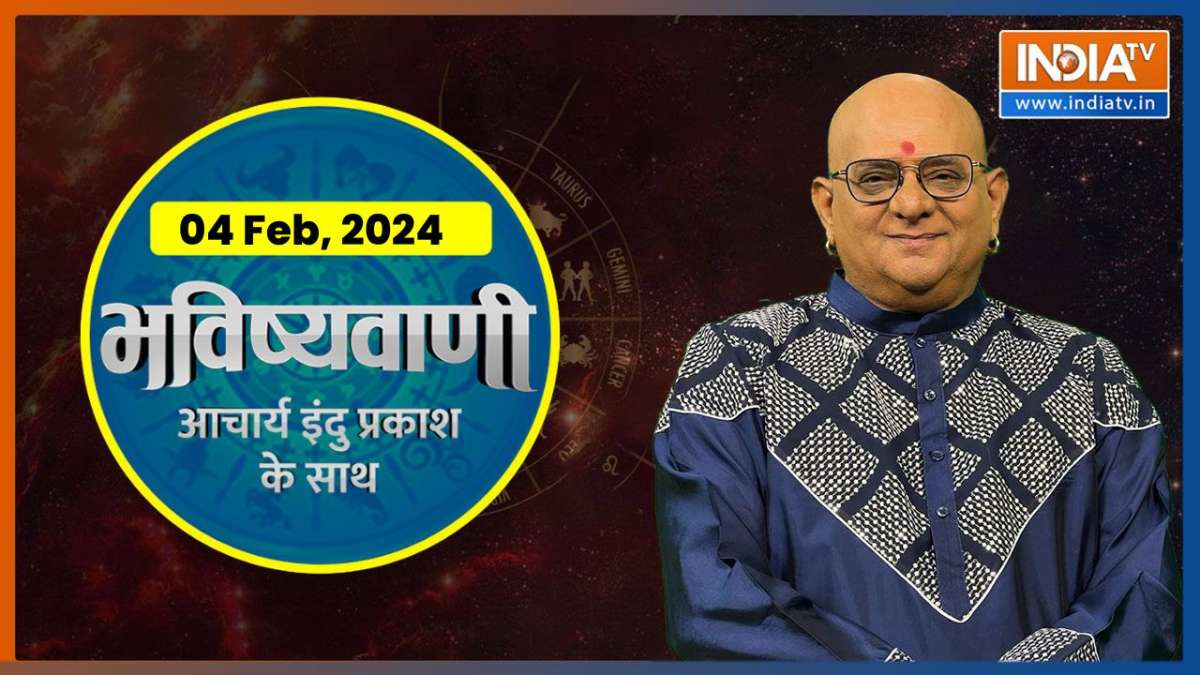

In contemporary India, astrology is no longer limited to tradition. It operates as a large and organized industry.
Television channels run daily predictions. Mobile applications offer instant consultations. Social media platforms amplify astrologers as influencers. Paid services range from basic horoscopes to expensive rituals and gemstones.
The system functions on demand. People seek answers about career, relationships, health, and uncertainty. Astrology provides those answers quickly, often without requiring evidence.
From a business perspective, it is effective.
Predictions are often general enough to apply broadly. When they fail, they can be reinterpreted. When they appear correct, they reinforce belief.
There is no formal regulatory system. There is no standardized testing. And there are no consequences for incorrect predictions.
Where It Becomes Dangerous: When Belief Turns Into Control


Belief by itself is not always harmful. The problem begins when belief creates dependency.
When individuals begin to rely completely on astrologers for decisions, they give away personal agency. This creates a power imbalance.
In such situations, the astrologer is no longer just an advisor. They become an authority figure.
And authority without accountability can be misused.
This is not a theoretical concern. It is visible in real-world cases.
From Belief to Exploitation: When Astrology Links With Crime
The recent case of Ashok Kharat is one example that has brought this issue into public discussion.
Kharat, a self-styled astrologer, has been accused of serious crimes including sexual exploitation. According to complaints, he allegedly used trust, fear, and spiritual claims to influence victims.
The pattern described in such cases is similar. Trust is built first. Emotional dependence follows. Then control develops.
In some cases, victims have reported coercion, manipulation, and even blackmail. Reports of digital evidence and multiple victims have further intensified concerns.
Such cases are not limited to one individual. India has seen multiple incidents involving self-styled godmen, spiritual leaders, and astrologers accused of fraud, sexual exploitation, or financial scams.
This does not mean all practitioners are involved in wrongdoing. But it highlights a structural risk.
Where belief is high and accountability is low, misuse becomes possible.
Why Astrology Continues to Survive


Astrology survives not because it is consistently proven, but because it fulfills a psychological need.
Human beings prefer certainty over uncertainty. They seek explanations, especially during stress.
Astrology provides immediate answers.
Science often requires time, evidence, and uncertainty. Astrology offers clarity, even if that clarity is not verifiable.
Social factors also play a role. Family traditions, cultural acceptance, media promotion, and celebrity endorsements all reinforce belief.
In many cases, questioning astrology is seen as questioning tradition itself, which makes open debate difficult.
The Core Issue: Not Astrology Alone, But Thinking Patterns
The deeper issue is not astrology alone. It is how people approach belief.
When questioning is discouraged, belief becomes rigid. When evidence is not required, claims cannot be tested.
India’s intellectual history includes strong traditions of logic, debate, and philosophy. At the same time, it also includes traditions of ritual and belief.
Astrology exists within this larger mix.
The challenge is not to eliminate belief, but to separate belief from authority.
Because when belief starts controlling decisions without accountability, it affects individuals and society.
Conclusion: A Complex Reality, Not a Simple Answer
Astrology in India is neither a simple ancient truth nor a complete modern invention.
It is a layered system shaped by history, cultural exchange, social change, and human psychology.
It began with observation of the sky, evolved through multiple influences, gained authority through tradition, and expanded into a commercial system in modern times.
At the same time, cases of fraud and exploitation show the risks when belief is combined with unchecked power.
Understanding this complexity is important.
Because the question is not whether astrology exists.
The real question is how it is used, how it is understood, and how much power it is given.
Support Independent Journalism
If you like our work and value deep, honest, and unfiltered reporting like this, consider supporting us. Your contribution helps us continue independent journalism.