
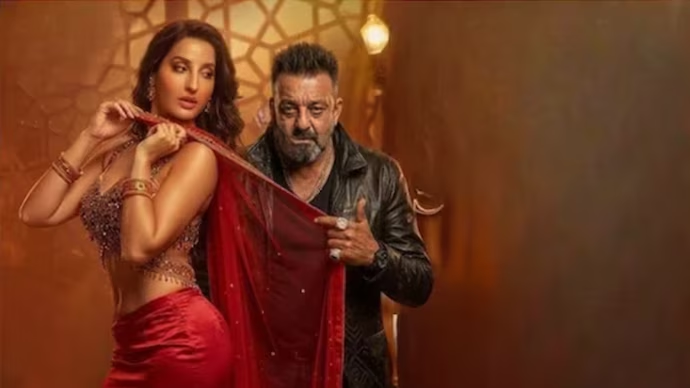
A newly released song featuring popular actors has triggered a wave of online reactions, with many users questioning not just the content of the song, but the response to it. While some viewers have called the lyrics bold or controversial, others are asking a deeper question: why does outrage seem selective?

The conversation quickly moved beyond the song itself. On social media platforms, users began comparing the reaction to similar content in regional industries, especially Bhojpuri music. For years, Bhojpuri songs have faced strong criticism for being vulgar or inappropriate. Critics often pointed to lyrics and visuals, calling for stricter censorship and moral accountability.
But now, many are noticing a different pattern.

When similar themes appear in mainstream Bollywood content, the intensity of criticism appears reduced. The same voices that once demanded accountability are either silent or less vocal. This contrast has led to a growing debate about double standards in how different film industries are judged.
Supporters of this view argue that the issue is not just about content, but about perception. Regional industries like Bhojpuri cinema are often judged more harshly, while mainstream Bollywood receives more leniency. According to them, this reflects a cultural bias where certain forms of expression are labeled as “low quality” or “vulgar” simply because of their origin.
Others, however, disagree. They argue that every piece of content should be judged individually, not compared across industries. For them, the focus should remain on the specific song, its lyrics, and its impact, rather than turning it into a broader cultural debate.
At the center of this discussion is a larger question about censorship and responsibility. In India, the role of regulatory bodies has often been debated, especially when it comes to defining what is acceptable in entertainment. Critics ask whether these standards are applied equally, or whether they shift depending on the platform, language, or audience.
This moment has also highlighted the power of social media in shaping public discourse. Reactions today are immediate, amplified, and often polarized. What might once have been a limited discussion is now a nationwide debate within hours.
Beyond the noise, one thing is clear. This is no longer just about one song. It is about consistency in standards, fairness in criticism, and the way cultural content is evaluated in India.
Whether this leads to a more balanced conversation or fades into another cycle of online outrage remains to be seen. But for now, the question being asked is simple and direct.
If the content is similar, why is the reaction different?