

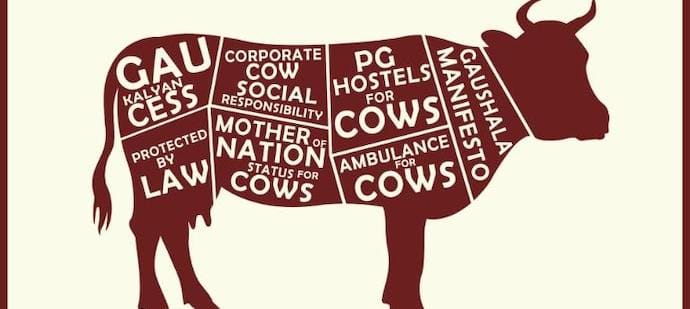
India’s political landscape is full of contradictions, but one of the clearest examples is the way “beef politics” is used. In states like Uttar Pradesh and Madhya Pradesh, strong narratives are built around vegetarianism, religious identity, and restrictions on beef. These narratives are often presented as moral or cultural positions. But when you look deeper, the reality is far more complex and uncomfortable.

India is one of the largest exporters of beef in the world. This is not a hidden fact. The industry exists, operates at scale, and contributes significantly to the economy. Large businesses, often with strong political connections, continue to function without major disruption. These companies are powerful, financially strong, and well-protected.
Now compare this with ground reality.
At the local level, ordinary citizens, especially poor people, small traders, or transporters, often face harassment, violence, or legal trouble over the same issue. The law, in practice, does not hit everyone equally. It is strict for the weak and flexible for the powerful. That is where the real contradiction lies.

Then comes the question of ideology.
If this issue was purely about belief or principle, it should remain consistent across the country. But it does not. In states like Kerala, Tamil Nadu, and many parts of the Northeast, where non-vegetarian food is a normal part of life, the same political voices suddenly soften or completely change their tone. The aggressive messaging seen in North India disappears. Why? Because it does not work there.
This shows a clear pattern. The issue is not really about culture or faith alone. It is about strategy.
Where beef can be turned into an emotional and polarizing topic, it is used heavily. Where it cannot bring votes, it is quietly ignored. Ideology bends depending on the audience.
This is classic vote bank politics.
Another uncomfortable truth is how power works in this system. Large exporters and influential business groups continue their operations because they have money and connections. They are rarely targeted. Meanwhile, enforcement becomes selective, often affecting those who lack protection.

So what we see is not a consistent moral position, but a layered system:
- One set of rules for powerful businesses
- Another set for ordinary citizens
- One narrative for certain states
- A completely different narrative for others
- In the end, this is less about food and more about control, perception, and political gain.

1 Comment