
For decades after independence, India proudly called itself the world’s largest democracy. Elections were held regularly, governments changed, and millions voted. Yet beneath that democratic image was a reality that many Indians had accepted as normal. Political parties distributed cash, liquor, and gifts to influence voters. Government machinery was often misused during election campaigns. Wall posters covered public property. Loudspeakers blared through the night. Candidates routinely spent far beyond legal limits. Powerful politicians behaved as if election laws existed only on paper. The Election Commission, which was supposed to ensure free and fair elections, was viewed by many as a weak institution that issued guidelines but rarely enforced them.

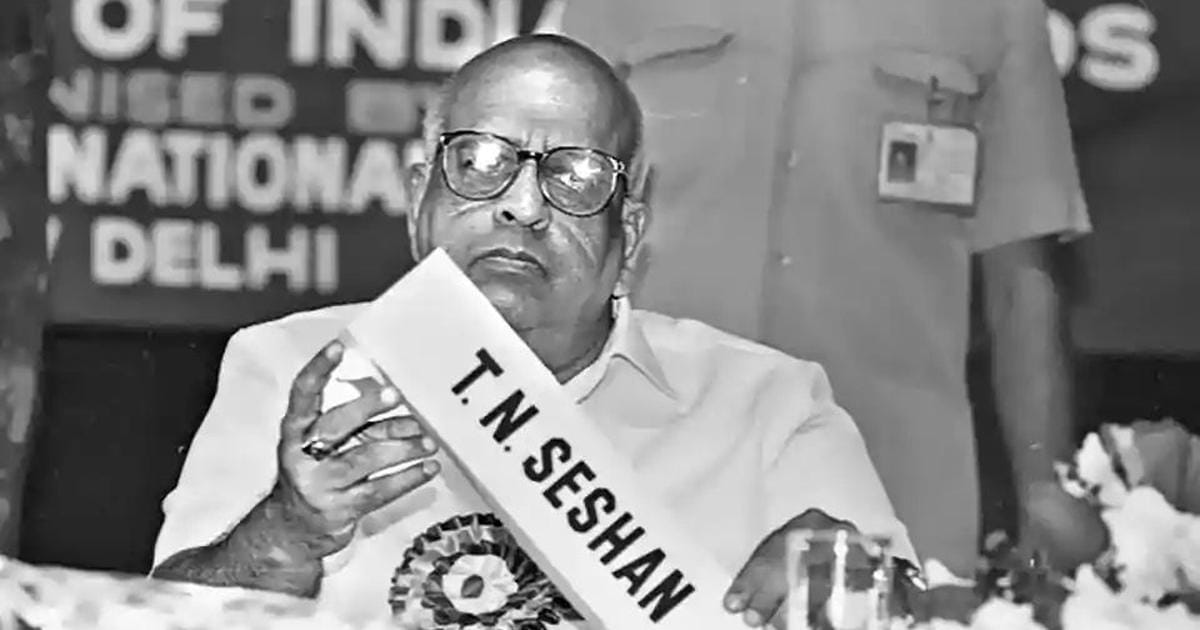
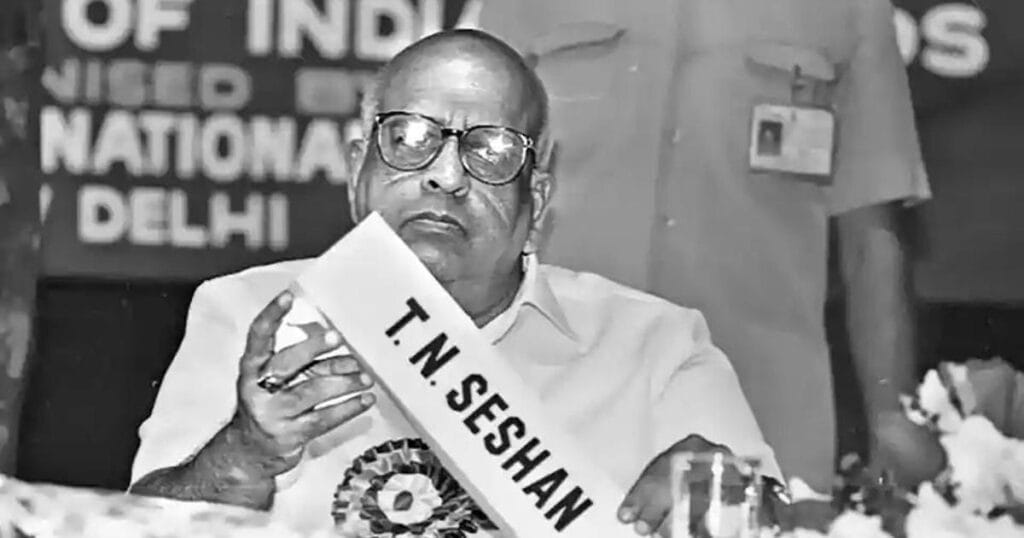
Then came Tirunellai Narayana Iyer Seshan, better known as T. N. Seshan.
Born in 1932 in Palakkad, Kerala, Seshan was not a politician. He was a career civil servant from the Indian Administrative Service. He had a reputation for discipline, intelligence, and an uncompromising attitude. Throughout his bureaucratic career he served in several important positions, including Cabinet Secretary, one of the highest posts in the Indian administration. But the role that would define his legacy arrived in 1990, when he became the Chief Election Commissioner of India.
At the time, few people expected his appointment to change the country. Election Commissioners before him had generally remained low-profile administrators. Seshan had different ideas. He believed that the Constitution had already given the Election Commission enormous powers. The problem was not the absence of authority. The problem was the absence of willingness to use it.
From the moment he took charge, Seshan began enforcing rules that had long been ignored. Political parties suddenly discovered that election laws were not mere suggestions. The Model Code of Conduct, which many politicians had treated as a ceremonial document, became a real instrument of accountability. Ministers were warned against using government resources for election campaigning. Officials were transferred when neutrality was in doubt. Campaign violations attracted immediate attention from the Commission.
The reaction from political circles was shock. Leaders across party lines were accustomed to operating with minimal oversight during elections. Now they faced an Election Commissioner who was not interested in political friendships, ideological loyalties, or personal convenience. Seshan repeatedly declared that his duty was to the Constitution, not to politicians. His office became feared because it could no longer be ignored.
One of his biggest contributions was cracking down on electoral malpractice. During that period, booth capturing remained a serious concern in parts of India. Criminal gangs or political workers sometimes physically took control of polling stations and manipulated votes. Seshan ordered stricter monitoring, stronger deployment of security forces, and greater scrutiny of polling arrangements. Elections that appeared compromised were not simply accepted. In several cases, polling was postponed or countermanded when fairness was questioned.
He also targeted the culture of inducements and freebies used to influence voters. While politicians had long distributed gifts, money, liquor, and other benefits to secure electoral advantage, Seshan insisted that such practices violated the spirit of democracy. His Election Commission aggressively monitored campaign activities and acted against violations. Candidates found guilty of breaching election laws could face disqualification, cancellation of polling in affected constituencies, or other punitive measures. For the first time, many political actors realized that breaking election rules could carry real consequences.
Seshan’s most powerful weapon was not force but credibility. He cultivated a public image that made ordinary citizens believe someone was finally standing up to political power. Newspapers carried stories of politicians being reprimanded by the Election Commission. Television discussions increasingly focused on electoral integrity. Citizens who had grown cynical about politics suddenly saw an institution willing to challenge powerful leaders. In many ways, Seshan transformed the Election Commission from a bureaucratic office into one of the most respected constitutional institutions in India.
His tenure was marked by frequent confrontations with the political establishment. Perhaps the most significant tensions emerged during the government of Prime Minister P. V. Narasimha Rao. Rao’s government was overseeing major economic reforms and navigating complex political challenges, but it also found itself dealing with an Election Commissioner who refused to operate quietly.
The relationship between Seshan and the political class became increasingly strained because he interpreted the Commission’s powers very broadly and exercised them aggressively. Many politicians felt he was exceeding his authority. Seshan argued the opposite: he was merely enforcing powers that already existed under the Constitution. The conflict was ultimately about a larger question. Who truly controlled the electoral process in India: elected governments or an independent constitutional authority?
The tension reached a major turning point when the government appointed two additional Election Commissioners. Critics of the move argued that it was intended to dilute Seshan’s authority by reducing the concentration of power in a single individual. Seshan strongly opposed the decision and challenged it legally. The dispute eventually reached the courts. Although the Supreme Court upheld the multi-member Election Commission structure, the controversy highlighted the extraordinary struggle between an assertive constitutional office and the political establishment.
Yet even when he lost institutional battles, Seshan often won the larger public argument. Indians increasingly viewed him as a symbol of independence and integrity. His blunt language, fearless public statements, and refusal to flatter political leaders made him one of the most recognizable public figures of the 1990s. He demonstrated that constitutional offices did not have to function as passive observers. They could actively defend democratic principles.
What made Seshan unique was that he challenged politicians regardless of party affiliation. He was not known for protecting one ideology while targeting another. Congress leaders criticized him. Opposition leaders criticized him. Regional parties criticized him. Many of the people who attacked him politically would later acknowledge that he changed the culture of Indian elections. His loyalty appeared directed toward institutions rather than parties.
This is why many Indians remember T. N. Seshan not as a partisan figure but as an institutional nationalist. He believed that a strong nation required strong democratic processes. In his view, patriotism was not blind support for governments. Patriotism meant protecting the credibility of institutions that allowed democracy to function. Free and fair elections were not technical procedures. They were the foundation of public trust in the Republic.
The impact of his tenure extended far beyond the years he served. Modern Indian elections, with stricter enforcement mechanisms, increased monitoring, stronger oversight of campaign practices, and greater public expectations of electoral fairness, owe much to the precedent he established. Many reforms introduced after his tenure became easier because he had already changed public expectations. Citizens no longer accepted the idea that election laws were optional. Politicians could no longer assume that violations would be ignored.
Of course, T. N. Seshan was not without critics. Some argued that his style was confrontational and occasionally theatrical. Others believed he concentrated too much authority in his office. Yet even many critics acknowledged that he forced India to take election law seriously. He transformed the Election Commission from a little-known institution into one of the most respected guardians of constitutional democracy.
Today, decades after his tenure, the phrase “before Seshan and after Seshan” is still used by many observers to describe the evolution of Indian elections. Few civil servants have left such a visible mark on public life. Fewer still managed to challenge the entire political establishment while retaining public support.
T. N. Seshan did not change India through elections won, political rallies addressed, or parties created. He changed India by insisting that the rules already written in the Constitution should actually be enforced. In a country where many believed power always belonged to politicians, he reminded the nation that institutions matter too. His legacy remains a powerful lesson that one determined public servant, armed with constitutional authority and personal courage, can alter the course of a democracy.