

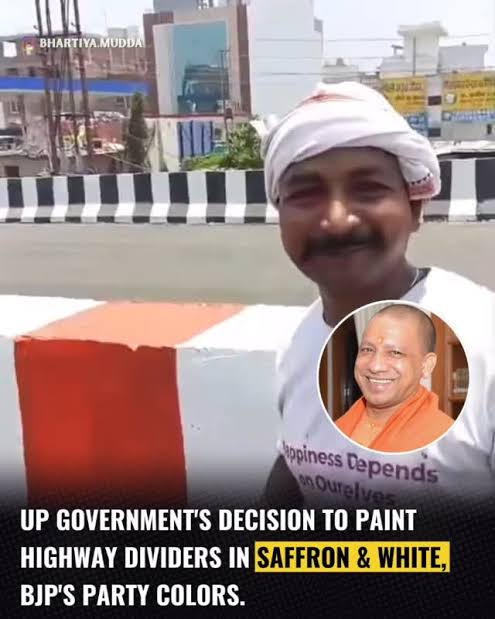
Lucknow: A viral video allegedly showing road dividers in Uttar Pradesh being repainted from black-and-white to saffron-and-white has triggered a fresh debate on public spending, governance priorities, and the role of symbolic politics in public administration.
The footage, widely shared across social media platforms, appears to show workers repainting dividers that were already painted and maintained. The video has led many users to question whether taxpayer money is being spent on projects that provide little practical benefit to citizens.
Critics argue that such exercises raise important questions about government priorities at a time when many Indians continue to face concerns related to inflation, unemployment, infrastructure, healthcare, and education. They contend that public funds should primarily be directed toward projects that deliver measurable improvements in people’s daily lives rather than cosmetic or symbolic changes.
The controversy has also revived a broaer political debate about identity-based politics in India. Some observers claim that visible symbolic measures linked to religion, culture, or political messaging often generate greater public attention than discussions surrounding economic development and governance reforms. According to critics, this can shift public discourse away from issues such as job creation, rising living costs, public services, and administrative accountability.
Political analysts note that symbolism has long played a role in democratic politics across the world. However, they argue that governments must be prepared to justify public expenditure and demonstrate clear public value whenever taxpayer funds are used for projects that are perceived as non-essential.
The viral video has also resonated with younger voters, many of whom have expressed frustration online about what they describe as divisive vote-bank politics. Several social media users argued that excessive focus on religious and identity-based narratives risks deepening social divisions while diverting attention from economic and developmental challenges facing the country.
Supporters of the government, meanwhile, maintain that aesthetic improvements, beautification projects, and uniform public infrastructure are legitimate functions of local administrations. They argue that isolated video clips do not always provide the complete context behind government decisions or budget allocations.
Regardless of political affiliation, the incident has renewed calls for greater transparency in public expenditure. Citizens and commentators alike are demanding clear answers about the necessity, cost, and purpose of such projects, emphasizing that accountability remains a cornerstone of democratic governance.
As the debate continues online, one question remains at the centre of public discussion: should limited taxpayer resources be spent on repainting structures that are already functional, or should those funds be prioritised for pressing public needs that directly affect citizens’ lives?