

A 17-year-old student asks a question. He alleges that the Physics answer sheet uploaded during the CBSE photocopy and re-evaluation process does not belong to him. He shares screenshots. He explains his concerns publicly. The post goes viral. Millions see it. Major media outlets begin reporting on the controversy. Citizens start asking whether a serious mistake may have occurred in one of India’s most important educational boards.
In a healthy democracy, this is where institutions respond. They investigate the claim, provide transparency, and reassure the public that the matter will be handled fairly. Questions are answered with facts. Evidence is examined. Accountability follows.
But that is not what happened on social media.
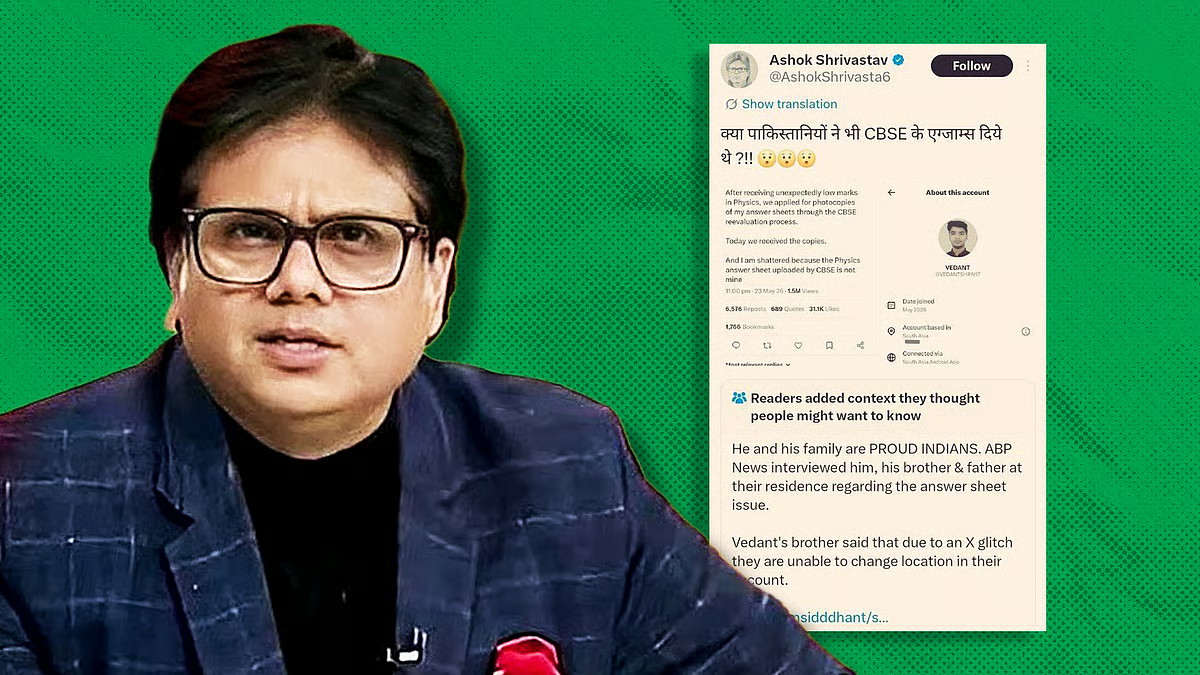
Instead of discussing the student’s allegations, a senior journalist, Ashok Shrivastav, posted a remark asking whether Pakistanis had also appeared for CBSE examinations. The implication was obvious. The target was obvious. The timing was obvious. A teenager raising questions about a possible irregularity suddenly found himself being portrayed through the language of suspicion rather than through the language of evidence.
This is precisely where the real story begins.
The controversy is no longer only about an answer sheet. It is now about how sections of India’s public discourse react when ordinary citizens challenge powerful institutions. A student did not organize a political movement. He did not contest an election. He did not attack the Constitution. He simply questioned a process after claiming that the answer sheet shown to him did not match his own work. Whether his allegation ultimately proves correct or incorrect is a matter for verification. Raising the question itself is not a crime. It is a right.
Democracies depend on citizens asking questions. Every major reform in history began because someone challenged an official narrative. Journalists traditionally understood this better than anyone else. The purpose of journalism was never to defend institutions from scrutiny. The purpose of journalism was to subject institutions to scrutiny. Reporters were expected to ask difficult questions, investigate uncomfortable facts, and hold authority accountable regardless of who occupied positions of power.
That is why many observers were surprised by the reaction. Instead of examining the student’s claim, the discussion shifted toward insinuation and labeling. The focus moved away from whether there had been an error and toward questioning the individual raising concerns. When public debate begins attacking the messenger rather than evaluating the message, truth becomes secondary to tribal loyalty.
The irony becomes even more striking when one examines the social media screenshot itself. The profile displayed a generic regional label: “South Asia.” Anyone familiar with geography knows that South Asia is not another name for Pakistan. South Asia includes India itself, along with several neighboring countries such as Nepal, Bangladesh, Sri Lanka, Bhutan, Maldives and Afghanistan. Millions of Indians fall under the broader South Asian category. Using such a label to imply foreign identity would make little logical sense.
Yet logic was never the point.
The deeper issue is the growing tendency to equate criticism of institutions with disloyalty to the nation. This confusion has become one of the most damaging trends in contemporary political discourse. Governments are not the nation. Political parties are not the nation. Educational boards are not the nation. Public institutions exist to serve citizens. Citizens do not exist to protect institutions from criticism.

If a student believes an answer sheet has been mismatched, questioning the board is not anti-national. If a taxpayer questions a government department, that is not anti-national. If a journalist investigates irregularities, that is not anti-national. Accountability is not hostility. Scrutiny is not sabotage. Democracy functions precisely because citizens possess the freedom to question authority.
The Vedant controversy also highlights a larger problem facing Indian media. Public trust in journalism has steadily eroded over the years. Many viewers increasingly believe that sections of the media spend more time defending political narratives than investigating facts. Whether that perception is fully accurate or not, incidents like this strengthen public skepticism. When a student raises a specific factual allegation and receives labels instead of answers, many people naturally wonder whether parts of the media have forgotten their fundamental role.
Journalism carries immense responsibility. A television anchor or senior journalist commands an audience that may number in the millions. Their words shape public opinion. Their statements influence perceptions. With such influence comes an obligation to remain careful, factual and fair. When that responsibility is replaced by mockery, insinuation or personal attacks, journalism begins to lose credibility.
The saddest aspect of this entire episode is the age of the person at the center of the controversy. We are not discussing a seasoned politician with access to power and resources. We are discussing a 17-year-old student. Students already face enormous academic pressure. Competitive examinations determine admissions, careers and opportunities. Anxiety levels are high. Expectations from families are high. The educational environment is intensely demanding. In such circumstances, public figures should exercise greater caution, not less.
The larger question India must ask itself is simple. What kind of society do we want to be?
Do we want a country where citizens can question institutions without being subjected to labels and insinuations?
Do we want journalists who investigate claims, or journalists who attack those making claims?
Do we want public debate driven by evidence, or public debate driven by identity politics?
The answers matter because today’s target may be a student, but tomorrow it could be anyone. Once questioning authority becomes socially unacceptable, accountability begins disappearing. When accountability disappears, mistakes remain hidden. When mistakes remain hidden, institutions become weaker rather than stronger.
Strong institutions do not fear scrutiny. Strong institutions welcome scrutiny because they know transparency increases public trust. A confident democracy does not silence questions. It answers them.
The Vedant-CBSE controversy may eventually be resolved through official clarification, investigation or documentation. Facts will determine the final outcome. But one lesson has already emerged. A society should never ridicule citizens simply for demanding answers. Whether those citizens are students, journalists, activists or ordinary taxpayers, their right to question authority remains fundamental.
Because in a democracy, asking questions is not the problem.
Refusing to answer them is.

2 Comments