

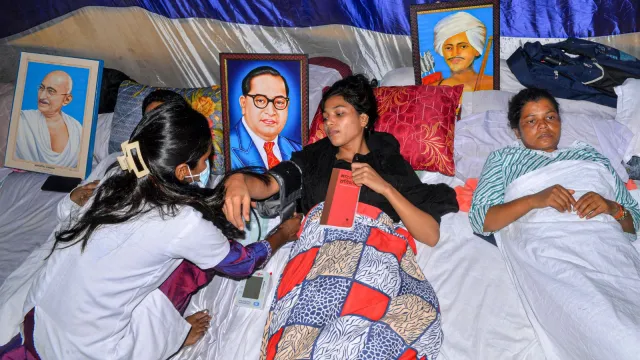
Student protests spread across India over examination irregularities, recruitment concerns, and education reforms, a new political debate emerged alongside them. Instead of focusing only on the students’ demands, public discussion increasingly shifted toward comparing different protests.
The most debated comparison has been between the Jantar Mantar student movement in Delhi and the ongoing student protest in Jharkhand. While both movements revolve around students demanding accountability and fairness, social media and political leaders have repeatedly compared them, leading to accusations that an artificial divide was being created.
This article examines those claims, the available evidence, and the political narratives surrounding the two movements.
The Battle Over the Narrative: Allegations of Attempts to Divide Student Movements
According to supporters of the Jantar Mantar student movement, the debate has gone beyond the protests themselves and has become a battle over public perception.
They allege that several social media pages, some self-described YouTube journalists, and sections of the mainstream media have attempted to portray the Jantar Mantar and Jharkhand student protests as fundamentally different movements. According to this view, the narrative suggested that the Jantar Mantar protesters should “learn” from the Jharkhand students, creating an unnecessary comparison instead of recognizing both as student-led movements with legitimate concerns.
Supporters argue that this amounts to a divide-and-rule strategy. They believe such messaging could weaken future nationwide student unity by encouraging students to see themselves as competing groups rather than allies fighting for common issues such as education, examinations, and recruitment transparency.
They also allege that some content creators attempted to enter the Jharkhand protest while presenting themselves as supporters of the students, but instead used the platform to spread negative narratives about the Gen Z activists who had previously organized the successful Jantar Mantar protest, including members of the Cockroach Janata Party and its founder, Abhijit Deepke.
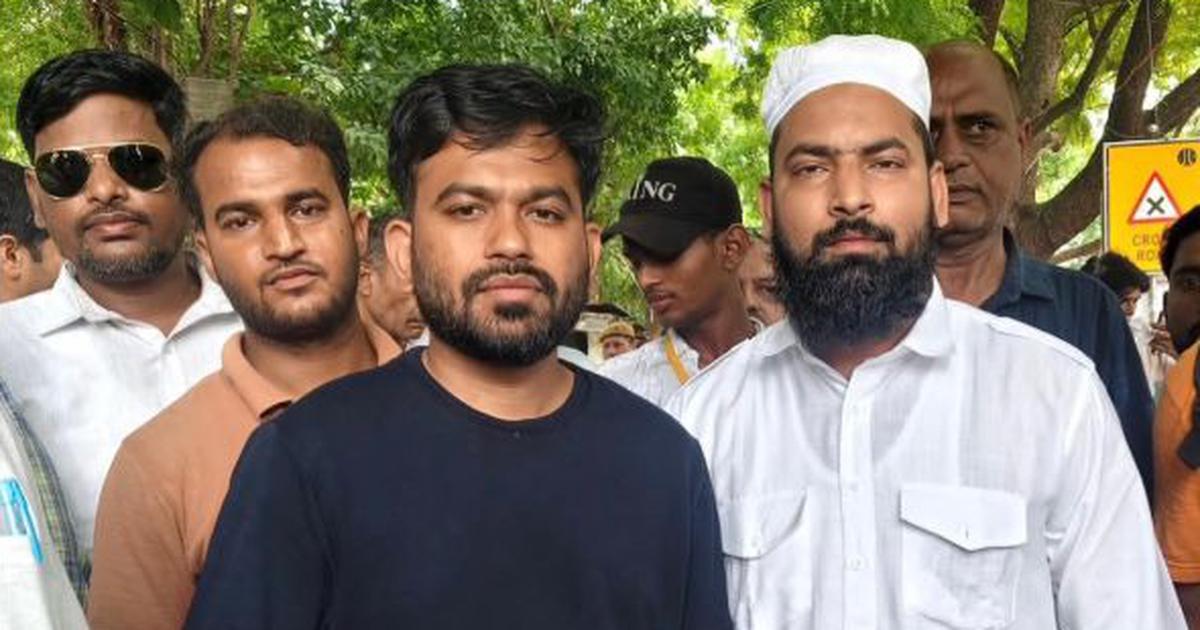
Another name repeatedly brought into the debate was Mohammad Junaid, who had helped provide food to students during the Jantar Mantar protest. Supporters allege that his name was unnecessarily dragged into discussions surrounding the Jharkhand protest in an attempt to discredit the earlier movement.
However, according to supporters of the movement, these efforts failed to gain lasting traction. They point out that Mohammad Junaid later visited the Jharkhand protest and publicly expressed solidarity with the students, which they argue undermined attempts to create a division between the two movements.
Whether these developments represent a coordinated strategy or simply competing political narratives remains a matter of public debate. What is clear is that the discussion increasingly shifted away from the students’ demands and toward competing narratives about who represented the “real” student movement. Supporters argue that this shift risks distracting attention from the core issues that brought students onto the streets in the first place.
Two Different Protests, One Common Theme
The Jantar Mantar protest grew into a nationwide youth movement demanding reforms in India’s examination system, accountability for paper leaks, and justice for students. The movement eventually led to major political developments, including the resignation of Union Education Minister Dharmendra Pradhan.
Meanwhile, students in Jharkhand launched their own protest over alleged irregularities in JPSC and JSSC recruitment examinations. Their demands focused on transparency, fair recruitment, and action against alleged examination irregularities.
Although the immediate issues were different, both protests centered on education, examinations, and opportunities for young people.
The Political Comparison
After Rahul Gandhi expressed support for the Jantar Mantar protesters, BJP leaders accused him of selective outrage, asking why he had not shown similar attention to students protesting in Jharkhand.
The criticism did not directly state that the two student groups were enemies. Instead, it argued that opposition leaders were choosing which protests to support.
This comparison quickly spread across television debates and social media.
Social Media Turns the Debate Into a Narrative
As political leaders exchanged accusations, social media users, influencers, and political supporters began framing the issue as a choice between two student movements.
Posts appeared asking questions such as:
- Why was one protest receiving national attention while another was not?
- Why were celebrities speaking about one movement but remaining silent on the other?
- Were some student protests considered more important than others?
Supporters of the Jantar Mantar movement argued that these comparisons distracted from the real issue. Instead of discussing examination reforms and student demands, the conversation shifted toward political point-scoring.
Saurav Das Rejects the Comparison
Cockroach Janta Party spokesperson Saurav Das publicly criticized attempts to compare the two movements.
His public statements argued that the Jharkhand students deserved support in their own right and should not be used to undermine or delegitimize another student movement.
His position was that support for one student protest should not require opposition to another.
Was There a Deliberate Divide-and-Rule Strategy?
This question has become a major topic of debate.
Many activists and supporters of the Jantar Mantar movement allege that political messaging and online campaigns attempted to create an “either-or” narrative, encouraging people to choose between supporting Jharkhand students or Jantar Mantar students.
However, it is important to distinguish between allegation and established fact.
Based on currently available reporting, there is evidence that political leaders compared the two protests and accused opponents of selective outrage. There is also clear evidence that social media amplified those comparisons.
However, there is no publicly available evidence proving a coordinated campaign specifically designed to divide the two student movements.
The Risk of Dividing Student Movements
Student movements often succeed when they build solidarity across regions.
When different groups are portrayed as competitors instead of allies, attention can shift away from the original issues, including examination reforms, recruitment transparency, and accountability.
Whether intentional or not, constant comparisons between separate student protests can create unnecessary polarization and reduce public focus on the underlying demands.
The Jharkhand and Jantar Mantar protests emerged from different immediate issues but reflected a broader concern shared by many young Indians about examinations, recruitment, and opportunities.
Political parties, activists, and commentators have framed these movements in different ways. Some presented them as examples of selective political support, while others argued that comparing them created an unnecessary divide.
At present, available evidence supports the claim that political comparisons were made. It does not conclusively prove that there was a centrally coordinated campaign to divide the two movements.
As with any politically charged issue, readers should distinguish between verified reporting, political messaging, and opinion circulating on social media.
1,460 Comments