
Tamil Nadu’s uncomfortable truth: When 14% growth loses to star power
In Tamil Nadu, the recent election has forced a difficult question into the open. What matters more in a democracy, governance or image? Because the result suggests that even visible development may not be enough when it collides with mass hero culture.
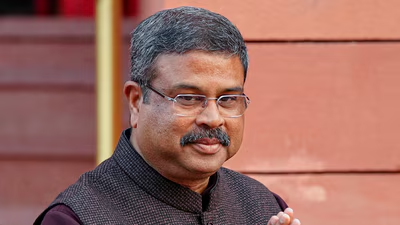
Under M. K. Stalin, the state focused heavily on policy-driven governance. His administration pushed education reforms, strengthened public schooling, and continued welfare systems like the Midday Meal Scheme. Economic performance was also highlighted by supporters, often described politically as around 40 percent growth during his tenure. Tamil Nadu continued to rank among stronger states in terms of human development and public service delivery.
On paper, this is a stable and functional governance model.
But elections are not decided on paper.


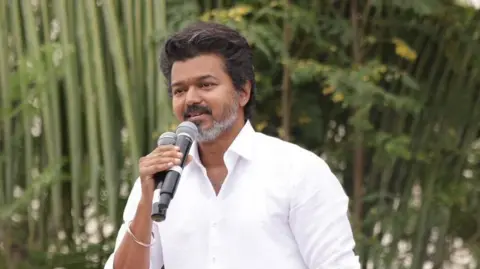
Despite these efforts, the result moved in another direction. Vijay, a film star without a comparable record in governance, emerged as the central political force. His advantage did not come from years of administrative work. It came from visibility, familiarity, and emotional connection built through cinema.
This is where the narrative becomes uncomfortable.
Because it points to a shift in how political decisions are being made. When a leader associated with policy, welfare, and institutional governance loses ground to a personality-driven figure, it suggests that evaluation is no longer based only on performance. Recognition begins to outweigh record.


This is not just about one election result. It reflects a deeper pattern.
Hero worship has long existed in South India, especially where cinema and politics intersect. But when that culture directly shapes electoral outcomes, it raises a structural concern. The boundary between admiration and political judgment becomes weak. A familiar face becomes a trusted choice, even without a tested governance record.
Tamil Nadu has historically positioned itself as a rational and reform-driven society, influenced by thinkers who challenged blind belief and promoted critical thinking. That identity is important. But this election shows that emotional influence still operates strongly beneath that surface.
The contradiction is clear.
A state that invests in education and rational policy can still be driven by symbolic leadership at the ballot box.

The concern is not about one individual winning or losing. It is about what determines that outcome.
If governance achievements such as economic growth, education expansion, and welfare delivery are not enough to secure political trust, then something more powerful is shaping voter behavior. That force is not policy. It is perception.
And when perception becomes stronger than performance, democracy enters a different phase.
The educated south and the myth of the infallible hero
In the public imagination, southern India carries a certain reputation. It is the part of the country that prides itself on literacy, social reform, and political awareness. From Tamil Nadu to Karnataka and Andhra Pradesh, the narrative is consistent: this is a region shaped by rational movements, anti-caste struggles, and a long intellectual tradition that challenged blind belief. Yet walk into a cinema release day in Chennai, Hyderabad, or Bengaluru, and that rational image begins to blur. Firecrackers explode at dawn. Milk is poured over towering cutouts. Posters are garlanded. Crowds gather not just to watch a film, but to participate in something closer to ritual.


The paradox is hard to ignore. In a region that often speaks the language of reason, cinema has created its own form of devotion. Actors are not merely entertainers. They are elevated, slowly and collectively, into figures of authority, morality, and emotional dependence. Over time, this transformation becomes normalized. It stops being surprising that an actor might be seen as a future political leader. It stops being unusual that a film release resembles a religious festival.
The roots of this culture run deep. South Indian cinema has never been just storytelling. It has been a vehicle for identity. In Tamil Nadu especially, cinema and politics have long been intertwined. The Dravidian movement used film as a tool to spread ideology, and actors became the faces of political messaging. Figures like M. G. Ramachandran and J. Jayalalithaa did not merely transition into politics. They carried their cinematic persona into governance. In Andhra Pradesh, N. T. Rama Rao followed a similar path, turning screen charisma into electoral power. These were not isolated cases. They created a template. They taught generations of voters that a hero on screen could also be a savior in real life.


Once that line is crossed, it is difficult to redraw it. Cinema begins to shape political expectations. The hero who fights corruption in a film becomes the leader who can fix society. The dialogue delivered on screen becomes a promise, even if it was never intended to be one. In this environment, fans are not just audiences. They are participants in a narrative that extends beyond the screen.
It is here that devotion takes a more visible form. There are documented instances of temples built for actors such as Rajinikanth. There are fan groups that perform rituals for Vijay, offering milk, flowers, and prayers to posters and cutouts. These acts mirror religious practices so closely that the distinction becomes symbolic rather than real. The language used by fans reinforces this shift. Words like “leader,” “savior,” and “god” are not metaphors. They are expressions of genuine belief.


The modern phase of this culture can be seen in the rise of Vijay. His following is not just large. It is organized, disciplined, and deeply emotional. Fan clubs operate with a structure that resembles political networks. Social work, public messaging, and coordinated campaigns are common. Even before formal political entry, the groundwork is laid. The transformation from actor to leader is no longer a leap. It is an expected progression.
What makes this phenomenon more complex is the social context in which it exists. South India is not an uneducated region driven by ignorance. It is, by most measures, more literate and politically aware than many other parts of the country. It has produced thinkers like B. R. Ambedkar and Periyar E. V. Ramasamy, who argued strongly against blind faith and the dangers of unquestioned authority. Their ideas shaped public discourse, influenced policy, and redefined social hierarchies.
And yet, the same society participates in a culture that often suspends critical thinking when it comes to cinematic figures.


This is not simple contradiction. It is coexistence. Rationality and emotion operate in parallel, each dominating different spaces. In classrooms, workplaces, and policy debates, reason prevails. In cinema halls and fan gatherings, emotion takes over. The danger lies in what happens when these two worlds overlap, particularly in politics.
Hero worship becomes problematic when it discourages questioning. Democracy depends on scrutiny, on the ability to challenge leaders and hold them accountable. When a public figure is elevated to near-divine status, that scrutiny weakens. Criticism is seen as disloyalty. Debate becomes personal. Policy discussions are replaced by image and perception.
This is not unique to South India, but the intensity here gives it a distinct character. The scale of fan mobilization, the visibility of rituals, and the historical link between cinema and governance amplify the effect. What might remain harmless admiration elsewhere can evolve into a powerful political force here.
There have also been unsettling reports over the years of fans reacting in extreme ways to developments involving their idols. Whether fully verified or amplified through rumor, these stories persist because they align with a visible truth: the emotional investment is real, and in some cases, overwhelming. The idea that a person’s identity can be tied so closely to a public figure is not abstract. It is lived reality for many.
At its core, this phenomenon raises a difficult question. How does a society that values education and rational thought also sustain a culture of intense personal devotion? The answer may lie in the human need for symbols. Cinema provides heroes who are clear, decisive, and morally certain. Real life is far more complicated. In that gap, the hero becomes a comforting figure, someone who represents what people wish leadership could be.
But comfort can come at a cost.
When admiration crosses into unquestioning belief, it stops being harmless. It begins to shape decisions, influence elections, and redefine public expectations. It shifts power away from institutions and toward individuals.
South India today stands at this intersection. It is a region of progress and contradiction, of logic and emotion, of reform and ritual. Its cinema continues to produce larger-than-life figures. Its society continues to negotiate what those figures mean.
The question is not whether people will admire their heroes. That is inevitable.
The question is whether they will continue to believe in them without question.