
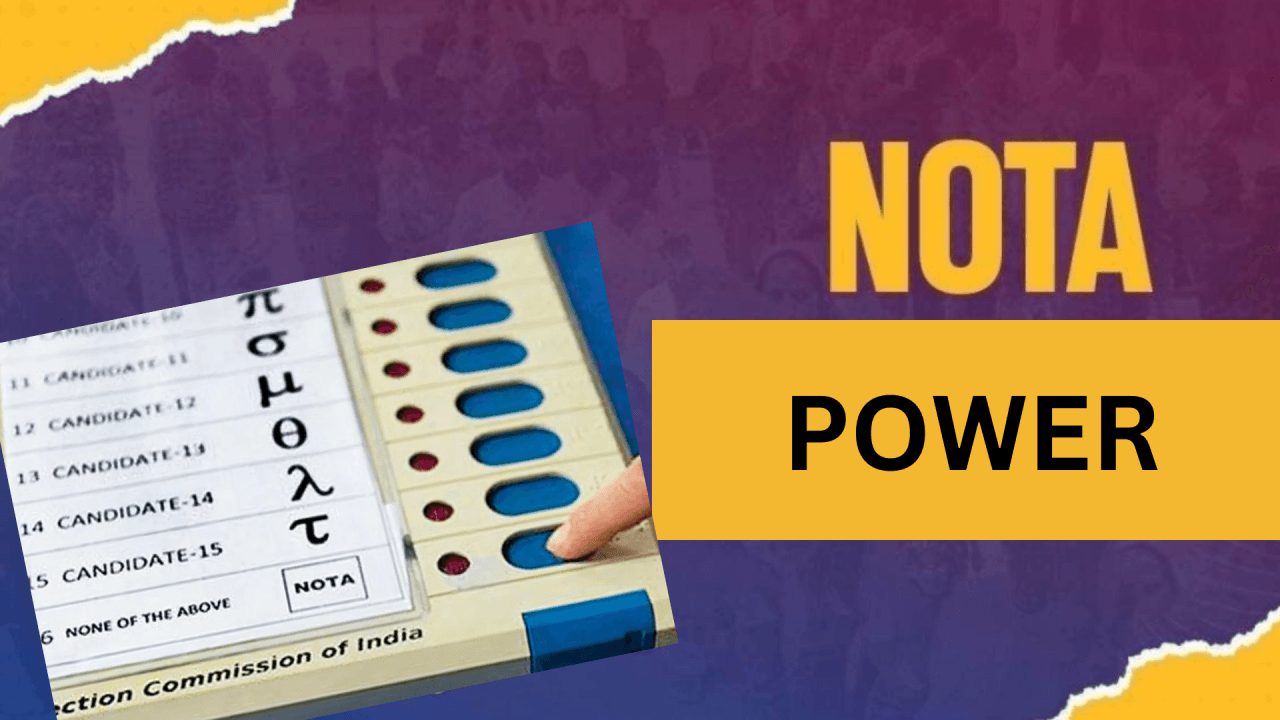
In every election cycle in India, a familiar argument returns. Many voters say they do not support any political party, so they choose NOTA, which stands for None of the Above. It feels like a clean and principled decision. You reject all candidates and take a moral stand.
But there is a hard truth that most people ignore. NOTA does not change the result. It only creates an illusion of protest.

What NOTA Actually Does
NOTA is counted. It is recorded. But it has no legal power.
Even if NOTA receives the highest number of votes in a constituency, the candidate with the highest votes among the remaining options still wins. There is no rule to cancel the election. There is no re-election. There is no punishment for political parties.
So in reality, NOTA is not a tool of change. It is only a symbolic choice.
The Illusion of Taking a Stand
Many people believe that choosing NOTA is a strong message. It feels like you are rejecting a broken system.
But the system does not respond to that message.
NOTA votes are treated like numbers, not like pressure. Political parties do not change their candidates because of NOTA. There is no incentive for improvement. There is no accountability created.
It exists. It feels meaningful. But it changes nothing.
Aristotle and the Lesser Evi

The idea behind voting is not always about choosing the perfect option. Sometimes, that option does not exist.
Aristotle explained this long ago with the idea of the lesser of two evils. When all choices are flawed, you choose the one that causes less harm.
This is not about morality. It is about consequences.
In a system like elections, refusing to choose does not stop the outcome. It only removes your influence from it.
The Real Impact of NOTA
When people choose NOTA, they step out of the decision-making process.
But elections still produce winners.
And when the worst candidate wins, the impact is not equal. The people who suffer first are the most vulnerable. Poor communities, marginalized groups, and those without power are affected the most.
So the question is not about feeling right. The question is about what happens after the result.
Why NOTA Fails as a Tool of Change

NOTA fails because:
- It does not affect election results
- It does not force re-elections
- It does not punish political parties
- It does not create pressure for better candidates
It only allows voters to express dissatisfaction without any real consequence.
That is why it is a failed system.
What Should Voters Do Instead
The uncomfortable truth is this. Democracy is not always about ideal choices. It is often about practical decisions.
Instead of asking who is perfect, ask:
- Which option causes less harm
- Which candidate is less dangerous
- Who will protect vulnerable people
Voting is not about personal satisfaction. It is about real-world outcomes.
NOTA gives a sense of moral clarity, but it does not improve democracy. It allows people to feel right while the system continues unchanged.
If the goal is real impact, then disengaging is not the answer. Participation with awareness is.
That may not feel inspiring, but it is honest.
So what should you do?
There is an idea called the “lesser of two evils.” It means when all options are bad, you choose the one that causes less harm. It is not a perfect choice, but it is more practical.
Choosing NOTA just to feel morally clean does not help others. It focuses only on your feelings, not on what happens in reality when a worse candidate wins.
So instead of asking, “Who deserves my vote?” ask, “If the worst candidate wins, who will suffer the most?”
Usually, it is poor and vulnerable people who are affected first.
So vote in a way that prevents the worst outcome. That is the practical way to think.
It may not feel inspiring, but it is honest. And the fact that this is the best advice in a democracy is the real problem.
Share this with people who are thinking about voting NOTA.