
india often describes itself as the world’s largest democracy, but democracy is not measured only by elections. A country can hold elections regularly and still fall into political stagnation. Real democracy is tested by one uncomfortable question: can voters remove powerful governments without fear, emotional manipulation, or blind loyalty?

This is where Kerala stands out in the Indian political landscape.
Kerala’s political culture is unusual compared to many other Indian states. For decades, power has largely alternated between the Left Democratic Front led by communists and the United Democratic Front led by Congress. Governments rise, lose support, get voted out, and then return again years later. The cycle repeats, but the deeper point is not the parties themselves. The deeper point is that voters continue to believe governments are temporary, not permanent.
That mindset changes everything.
The Difference Between Voting and Democratic Accountability

In many democracies, elections slowly become personality contests. Political identity starts replacing governance. Voters stop evaluating performance and begin defending leaders emotionally, almost like cultural or religious symbols. Once this happens, democratic accountability weakens.
Kerala developed differently.
The state built a political culture where criticism of government became normal. Political discussion entered homes, schools, tea shops, colleges, trade unions, libraries, and public spaces. Governments were treated as administrators, not untouchable rulers. That distinction matters.
When voters believe governments can and should be replaced, politicians behave differently. They know power is temporary. They know failure has consequences. They know public anger can remove them.
This does not eliminate corruption or political problems entirely. Kerala has its own controversies, ideological conflicts, and governance failures. But frequent political competition creates pressure. That pressure forces governments to remain responsive.
Democracy weakens when ruling parties begin believing defeat is impossible.
Literacy Is Not Just Reading. It Is Political Awareness

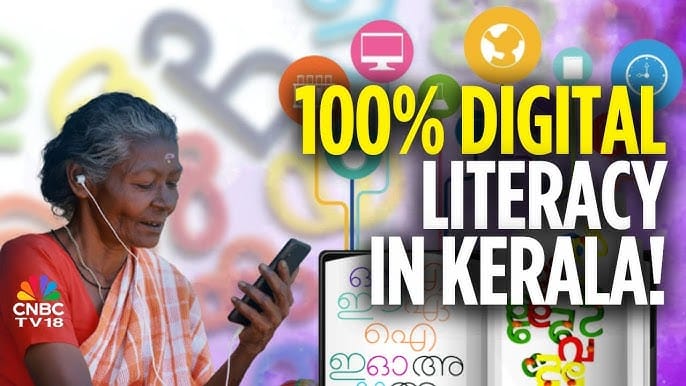
Kerala’s literacy model is often misunderstood. Literacy is not only about reading books or signing documents. Real literacy changes how people interact with authority.
Kerala invested heavily in:
- Public education
- Healthcare
- Social reform movements
- Grassroots political participation
This created a population that became politically vocal and socially aware. Citizens learned not only to read, but to question.
That questioning culture is important.
A highly aware electorate becomes difficult to emotionally manipulate for long periods. Religious identity alone becomes insufficient to guarantee political loyalty. Governments are constantly evaluated through:
- Prices
- Employment
- Welfare
- Public services
- Infrastructure
- Education
- Governance quality
This does not mean Kerala is free from identity politics. No Indian state is completely free from it. But compared to many regions, performance politics remains stronger.
The Legacy of Social Reform Movements
Kerala’s political consciousness did not emerge overnight.
The state was shaped by social reformers who challenged caste hierarchy, social exclusion, and illiteracy. Leaders like Sree Narayana Guru transformed public thinking by promoting education and dignity over rigid social divisions.
Christian missionary education, reform movements, left-wing labor politics, and strong trade union culture also contributed to mass awareness.
Unlike many regions where politics remained concentrated among elites, Kerala witnessed wider political participation across classes and communities.
This created a society where political engagement became part of daily life.
Why Frequent Change of Government Matters

Many people wrongly assume political stability means keeping one party in power for decades. But excessive concentration of power often creates the opposite effect.
Long-term uninterrupted dominance can lead to:
- Institutional weakening
- Personality cult politics
- Reduced accountability
- Administrative arrogance
- Corruption networks
- Fear within bureaucracy
A democracy survives through competition.
When governments know they can lose power, institutions remain more balanced. Opposition remains relevant. Media scrutiny increases. Public criticism stays alive.
This is why peaceful transfer of power matters more than emotional political loyalty.
Kerala’s alternating governments created a culture where defeat became normal, not catastrophic. Losing elections did not end democracy. It strengthened it.
Tamil Nadu: Another Example of Political Rotation


Tamil Nadu offers another important example.
For decades, politics in the state revolved around two dominant Dravidian parties: DMK and AIADMK. Power shifted repeatedly between them. Like Kerala, Tamil Nadu developed strong regional political consciousness and a highly engaged electorate.
Now, the emergence of TVK led by actor Vijay reflects another democratic reality: political systems continue evolving.
Whether TVK succeeds or fails is secondary. The important point is that new political forces can still emerge and challenge established structures.
That possibility is healthy for democracy.
When political systems become permanently closed, frustration grows. When systems remain open to change, public participation stays alive.
The Danger of Identity-Only Politics
Across India, many political narratives increasingly depend on identity:
- Religion
- Caste
- Region
- Language
Identity itself is not the problem. Every society has identities. The problem begins when identity completely replaces governance.
When voters stop asking:
- Is the economy improving?
- Are schools functioning?
- Are hospitals working?
- Is corruption reducing?
And only ask:
- Does this party represent “my people”?
Democracy becomes weaker.
Governments become emotionally protected from criticism. Support becomes unconditional. Accountability disappears slowly.
This is dangerous in the long term because democracies do not collapse overnight. They weaken gradually through normalization of unquestioned power.
Kerala’s Model Is Not Perfect, But It Shows Something Important
Kerala is not a utopia. It faces:
- Unemployment issues
- Migration dependency
- Political violence in some regions
- Economic pressures
But the state demonstrates one critical democratic principle:
No government should feel permanent.
That single political culture changes how power operates.
Democracy Requires Citizens, Not Followers


The health of a democracy depends less on politicians and more on citizens.
When citizens become followers, democracy weakens.
When citizens remain questioning participants, democracy survives.
Kerala’s political culture, despite its flaws, continues to show that governments are meant to be evaluated, challenged, and replaced when necessary.
That is not instability.
That is democracy functioning the way it was designed to function.
The real strength of democracy is not winning elections. It is the willingness of citizens to remove governments peacefully when they stop performing.
Kerala’s political history reflects that principle clearly. Tamil Nadu’s evolving political space reflects it too.
Democracy becomes dangerous when power becomes emotionally permanent.
It becomes healthier when voters remember one simple truth:
Governments are temporary.
Citizens are permanent.
Support Independent Journalism
If you like our work and value deep, honest, and unfiltered reporting like this, consider supporting us. Your contribution helps us continue independent journalism.