
Every few months in India, the same political drama returns.
A television anchor shouts about protecting cows. A politician promises stricter laws. A mob attacks a cattle transporter. Social media explodes with slogans about faith, nationalism, Hindu identity, and culture. Hashtags trend. Election speeches become louder. Another emotional cycle begins.

And then, quietly, behind all the outrage, India’s dairy economy continues exactly as before.
Milk trucks continue moving.
Dairy cooperatives continue expanding.
Farmers continue breeding cattle.
Old and economically unviable animals continue disappearing into informal and formal slaughter systems.
Because despite all the emotional speeches, modern India cannot sustain its dairy economy without confronting the uncomfortable reality of cattle disposal.
That is the truth hidden behind the politics.
For years, Indian politics has treated the cow less like an animal and more like a political symbol. The cow is now a campaign tool, a cultural weapon, an emotional trigger, and one of the most powerful vote-bank instruments in the country. But the deeper contradiction is rarely discussed openly.
The same India that claims moral outrage over cow slaughter is also the India that built one of the largest dairy industries on earth.
The same political ecosystem that speaks about sacredness also depends on the economics created by commercial cattle production.
And that contradiction changes everything.
The Reality Nobody Says Loudly Daily 8,000 to 10,000 Cows and Nearly 40,000 Buffaloes Are Slaughtered in India.
India’s cattle economy is far more complex than political slogans suggest. Every day, thousands of cattle are legally slaughtered across different states under licensed slaughterhouse systems. Estimates from livestock and meat industry data suggest that around 8,000 to 10,000 cows and cattle, along with nearly 35,000 to 40,000 buffaloes, are processed daily through legal channels in India.
The majority of buffalo meat, commonly called carabeef, enters domestic markets and export chains. India has been among the world’s largest buffalo meat exporters for years, supplying countries in Southeast Asia, the Middle East, Africa, and parts of Asia. Cow meat and cattle meat also enter local meat markets in states where legal slaughter is permitted under state laws.

But the most important fact ignored in public debate is this:
Most of these animals are not raised primarily for meat.
India’s livestock system is mainly driven by the dairy industry. Farmers raise cows and buffaloes mainly for milk production. Once animals become old, infertile, sick, or economically unproductive, they often enter legal cattle trade systems connected to slaughterhouses, leather industries, meat processing units, bone industries, and export businesses.
This means the dairy economy and meat economy are directly connected.
After slaughter:
- Meat is sold legally in domestic markets or exported
- Leather goes to India’s leather industry
- Bones and byproducts enter pharmaceutical, gelatin, and industrial sectors
- Animal fats are used in multiple commercial industries
Nothing is wasted in the commercial livestock chain.
This is why many agricultural economists argue that a complete nationwide cattle slaughter ban would deeply affect India’s dairy economy unless the government creates massive systems to maintain millions of non-productive animals.
The reality is uncomfortable but simple:
India’s cattle slaughter system exists not only because of meat demand, but because the dairy industry itself continuously produces surplus and aging livestock.
There is a sentence many politicians in India will never say publicly because it destroys the emotional simplicity of cow politics.
A large-scale dairy industry inevitably creates a large-scale cattle disposal problem.
This is not ideology.
This is economics.
A cow does not produce milk forever. Productivity declines with age. Male calves often become economically burdensome in a modern agricultural system where tractors replaced traditional bull labour decades ago. Farmers with tiny incomes cannot permanently maintain old or non-productive animals for emotional reasons alone.
India is not a small rural village economy anymore. It is a giant agricultural market connected to industrial supply chains, exports, leather production, pharmaceuticals, transport, dairy cooperatives, and food systems.
When politicians say “ban cow slaughter completely,” they almost never explain what happens next.
Who will feed millions of aging cattle?
Who will pay farmers?
Who will maintain shelters?
Where will the land come from?
How will already indebted rural families survive?
Nobody answers these questions honestly because the politics of emotion is easier than the politics of reality.
The Forgotten History of India’s White Revolution
To understand why this issue became so complicated, one must go back to the transformation of India itself.
In the decades after independence, India faced severe milk shortages. Milk was expensive, inaccessible, and insufficient for a growing population. Then came Operation Flood and the White Revolution under Verghese Kurien.
Kurien is celebrated as one of the architects of modern rural India. His dairy cooperative model transformed millions of lives. Villages gained income. Milk production exploded. India eventually became the largest milk producer in the world.

Politicians today proudly celebrate this achievement.
But very few acknowledge the economic consequences that came with it.
The White Revolution massively expanded India’s cattle economy.
More milk production required:
more breeding,
more cattle,
more dairy infrastructure,
more feed,
more veterinary systems,
and eventually more unproductive animals.
The dairy industry did not create only milk.
It also created surplus cattle populations.
This was always part of the system.
Kurien himself understood this contradiction. He repeatedly argued that emotional politics could not replace practical livestock management. He recognised that modern dairy economics required rational policy, not religious theatre.
But rational discussions rarely survive inside emotional democracies.
The Cow Became More Powerful Than Policy
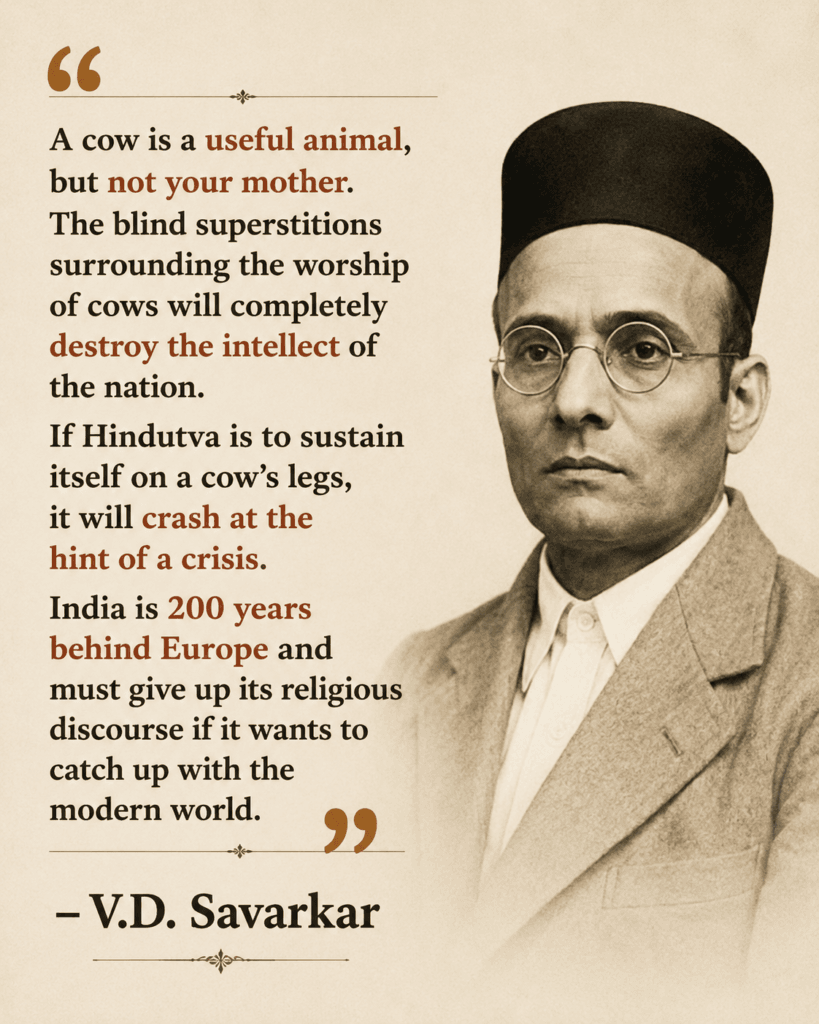
At some point, the cow stopped being discussed primarily as livestock and became something much bigger in Indian politics.
It became identity.
And once identity enters politics, rational debate becomes almost impossible.
The cow became tied to:
Hindu pride,
nationalism,
cultural insecurity,
religious mobilisation,
and electoral messaging.
The emotional force of cow symbolism became politically valuable because it could unite voters quickly without discussing complicated economic issues.
Farmer debt is complicated.
Livestock economics are complicated.
Rural unemployment is complicated.
Dairy reform is complicated.
But slogans are simple.
A politician standing beside a cow creates stronger emotional imagery than a policy paper on agricultural restructuring.
This is why cow politics survives despite its contradictions.
It was never only about animals.
It was always about mobilisation.
India’s Regional Hypocrisy
One of the strangest aspects of Indian cow politics is how dramatically it changes from state to state.
In parts of North India, politicians speak as if beef consumption itself is a civilisational threat. Public rhetoric becomes extremely aggressive. Vigilante groups emerge. Television debates turn hysterical.
But travel to several southern or northeastern states and the political language changes immediately.
In many parts of Kerala, Goa, the Northeast, coastal Karnataka, and other regions, beef consumption exists openly among different religious and caste communities, including many Hindus.
Suddenly, the same national outrage becomes quieter.
Why?
Because electoral realities are different.
Political morality in India often changes according to geography.
A practice condemned as “anti-Hindu” in one region becomes politically ignored in another where banning it would create electoral backlash.
This exposes the core truth behind much of cow politics:
it is often strategic before it is ideological.
If the issue were purely about universal moral principle, the political position would remain identical everywhere.
It does not.
Because votes matter more than consistency.
The Silent Violence Inside the Dairy Economy
India emotionally separates milk from slaughter as if the two belong to entirely different worlds.
They do not.
Modern dairy systems involve continuous reproduction cycles. Cows are repeatedly impregnated for milk production. Calves are separated. Male calves frequently become economically unwanted. Aging dairy cattle eventually stop being financially useful for poor farmers struggling to survive.
This is not unique to India.
It exists globally.
But India often refuses to discuss dairy ethics honestly while simultaneously turning slaughter into a national moral obsession.
The country romanticises milk while ignoring the industrial reality behind it.
One cannot seriously discuss cow protection while refusing to discuss commercial dairy production.
The two are inseparable parts of the same system.
A nation consuming enormous quantities of milk while demanding absolute cattle preservation without economic restructuring is essentially demanding an impossible contradiction.
The Politics of Fear and Spectacle
Over the past decade, Gau Raksha politics expanded beyond religion into public spectacle.
Cow vigilantism became performative power.
Videos of mobs stopping trucks spread online. Men carrying cattle were publicly humiliated. Muslims and Dalits increasingly became targets of suspicion. Fear itself became political currency.
Meanwhile, actual animal welfare often remained secondary.
India’s streets are filled with starving stray cattle eating plastic.
Rural farmers lose crops because abandoned cattle wander into fields at night.
Shelters remain overcrowded and underfunded.
Veterinary systems in many regions remain weak.
But these issues generate less television excitement than communal confrontation.
A starving cow quietly eating garbage does not produce viral outrage.
A communal conflict does.
And modern politics increasingly rewards visibility over substance.
The Stray Cattle Crisis Is a Policy Failure
One of the least discussed consequences of aggressive slaughter restrictions has been the explosion of stray cattle populations in several states.
Farmers who cannot economically maintain aging cattle often abandon them.
The result is visible everywhere:
highway accidents,
crop destruction,
urban cattle chaos,
and overwhelmed shelters.
Ironically, many small farmers privately complain about these policies while publicly remaining silent because cow politics became emotionally dangerous to challenge.
The burden falls disproportionately on the poor.
Urban middle classes may consume milk daily while celebrating symbolic cow protection online, but it is the rural farmer who must feed and manage economically unviable animals.
This is where ideological politics collides directly with agricultural reality.
The Economic Contradiction at the Heart of the Debate
India wants three things simultaneously:
To be the world’s largest milk producer.
To maintain emotional cow protection politics.
To avoid openly discussing slaughter economics.
But these three positions cannot permanently coexist without contradiction.
The dairy economy continuously generates cattle populations that require management.
If slaughter is entirely removed without massive structural reforms, the consequences would be enormous:
exploding stray cattle populations,
financial collapse for many farmers,
growth of illegal underground markets,
higher rural distress,
and greater pressure on already struggling agricultural systems.
This is why even governments using strong cow-protection rhetoric often operate with practical flexibility behind the scenes.
Reality forces compromise even when politics pretends otherwise.
The Real Victims
In elite political debates, the cow often becomes symbolic.
But for ordinary people, the consequences are material.
Poor dairy farmers suffer.
Transport workers suffer.
Leather workers suffer.
Meat industry labourers suffer.
Rural communities suffer.
Minority communities suffer.
Dalit workers suffer.
Meanwhile, political parties gain emotional narratives for elections.
The animal becomes secondary.
The symbolism becomes primary.
And that may be the most disturbing part of all.
Rational Debate Has Almost Disappeared
India desperately needs a serious national conversation about livestock policy, dairy ethics, rural economics, and animal welfare.
But rational debate has increasingly been replaced by emotional absolutism.
The conversation should actually be about:
scientific cattle management,
farmer support systems,
ethical dairy reform,
animal welfare standards,
rural sustainability,
and economic realism.
Instead, the debate is reduced to:
“Who loves cows more?”
That simplification benefits politics.
But it damages policymaking.
The Uncomfortable Truth
The uncomfortable truth is not that India has cows.
The uncomfortable truth is that India built an enormous commercial economy around cows while pretending that economy can function outside economic logic.
It cannot.
A complete nationwide ban on cattle slaughter without transforming the dairy economy itself would require one of the largest agricultural restructurings in Indian history.
It would mean:
massive public spending,
state-funded cattle maintenance,
new rural economic models,
land allocation,
population control systems,
and fundamental changes in milk production itself.
No government is seriously proposing this because the scale is economically overwhelming.
And so politics continues performing morality while reality quietly continues underneath.
Beyond Propaganda
The cow deserves better than becoming a permanent political weapon.
And ordinary Indians deserve honesty.
Not selective outrage.
Not mob violence.
Not emotional manipulation during elections.
Not propaganda disguised as morality.
India’s cattle economy is deeply tied to its dairy economy. Ignoring that connection may win votes, but it does not solve reality.
Real compassion requires more than slogans.
Real policy requires more than televised nationalism.
And real democracy requires the courage to discuss uncomfortable truths without fear.
Because facts remain facts, even when politics decides they are inconvenient.