
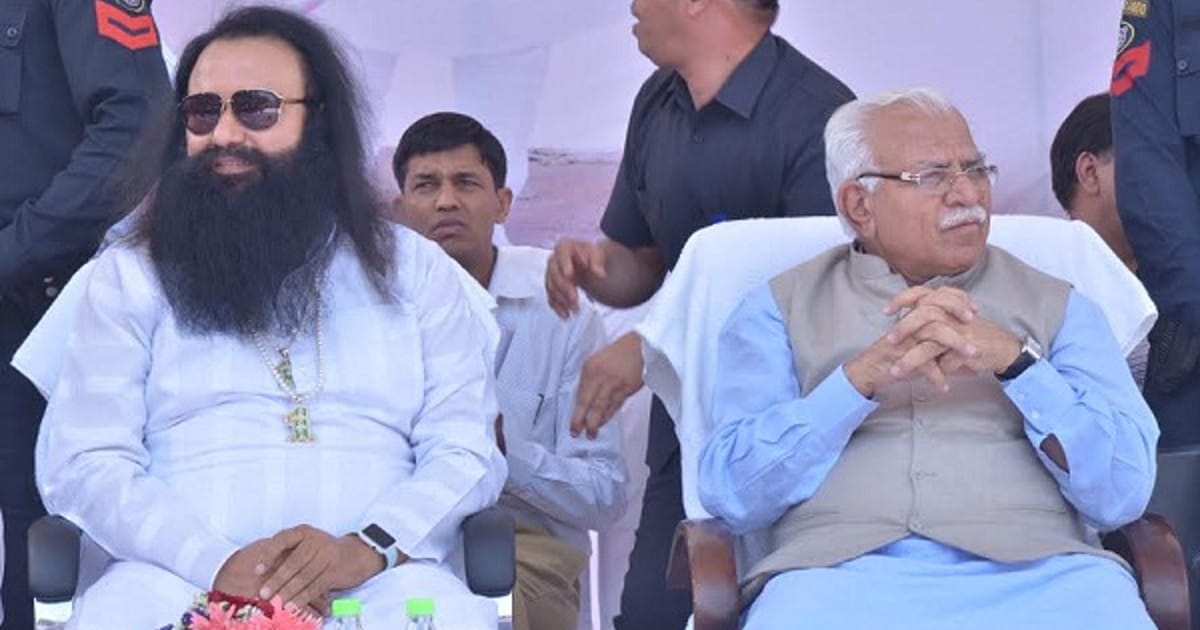
On 26 May 2026, Gurmeet Ram Rahim Singh once again walked out of Haryana’s Sunaria jail on a 30-day parole. For many Indians, the news barely felt surprising anymore. The Dera Sacha Sauda chief, convicted in rape and murder cases, has now received temporary release around sixteen times since 2020. Every new parole sparks the same questions. How does a man convicted of such serious crimes repeatedly leave prison? Why does the Haryana government continue approving these releases? And why do critics believe politics plays a major role in this story?

The Haryana Law That Changed Everything: How a 2022 Prison Reform Became the Biggest Loophole in the Ram Rahim Parole Controversy
For years, Haryana’s prison system treated “hardcore convicts” differently from ordinary prisoners. The logic was simple. Some crimes are considered so serious that the prisoners convicted in those cases should face stricter rules for temporary release. Convicts involved in repeated murders, organized violence, gang crimes, and certain extreme offences were placed in a category where parole and furlough became either highly restricted or nearly impossible.
Then in 2022, the Haryana government changed the framework.

At first glance, the Haryana Good Conduct Prisoners (Temporary Release) Act, 2022 looked like a technical prison reform law. The government described it as an attempt to modernize prison administration and standardize temporary release procedures for inmates. But within two years, the law became one of the most controversial prison reforms in India because critics believe it created a legal loophole that repeatedly benefited one man: convicted Dera chief Gurmeet Ram Rahim Singh.
The controversy is not about whether Ram Rahim’s paroles are technically legal. Most of them are legally approved. The controversy is about how the law itself was redesigned and interpreted in a way that critics believe weakened restrictions on serious convicts while preserving the appearance of legality.
Before 2022, Haryana already had parole laws. But “hardcore prisoners” faced major restrictions under earlier frameworks and amendments. Courts repeatedly treated this category cautiously because the assumption was that prisoners convicted in grave offences should not easily receive repeated temporary releases.
The 2022 law changed that structure in a very important way.
Section 6 of the Haryana Good Conduct Prisoners (Temporary Release) Act, 2022 says that even a hardcore convicted prisoner can eventually become eligible for parole and furlough after completing a certain number of years in prison with good conduct. Under the law, a hardcore convict who completes five years of imprisonment, including up to two years spent as an undertrial, without major jail offences, can become eligible for temporary release “at par” with ordinary convicted prisoners.
That single legal shift completely changed the debate around parole in Haryana.
Under the older public understanding of prison law, many Indians assumed that prisoners convicted of rape and murder would rarely leave jail except under extreme circumstances. But the 2022 framework introduced a rehabilitation-based approach that treated long-term good conduct as grounds for eligibility even for hardcore prisoners. Critics immediately warned that this would weaken the distinction between ordinary convicts and prisoners convicted of extremely serious crimes.
Then came the second major controversy: definition.
In 2024, it emerged that the Haryana government had taken legal opinion from Advocate General Baldev Raj Mahajan and concluded that Gurmeet Ram Rahim did not actually fall within the legal category of “hardcore convicted prisoner.” That shocked many people because Ram Rahim is convicted in rape and murder cases. But the law’s wording turned out to be highly technical.
The “hardcore prisoner” category under Haryana law is not based simply on public outrage or seriousness of headlines. It depends on precise statutory definitions. For example, serial killings across separate FIRs, organized criminal activity, and certain repeat violent offences are specifically mentioned categories. Haryana’s legal interpretation concluded that Ram Rahim’s convictions did not technically satisfy those exact conditions.
That interpretation changed everything.
Once the state legally decided that Ram Rahim was not a hardcore convict under the technical definition, he became eligible for the broader parole and furlough benefits available under the 2022 law. According to Haryana’s prison framework, eligible convicts can receive up to 70 days of parole and 21 days of furlough in a year.
This is the loophole critics keep talking about.
The loophole is not that Haryana openly passed a law saying “free Ram Rahim.” No government would ever write a law like that. The loophole is that the law was rewritten in a broad enough way, and the definitions interpreted narrowly enough, that a politically influential convict could repeatedly qualify for temporary release while remaining technically within the law.
And Ram Rahim’s case became the clearest example.
Since 2020, the Dera chief has received parole or furlough around sixteen times. Reports indicate he has spent more than 400 days outside prison despite serving sentences in rape and murder cases.
That frequency is what triggered national outrage.
Critics began asking questions ordinary people could easily understand:
Would an ordinary rape convict receive sixteen paroles?
Would a poor prisoner without political influence repeatedly receive such relief?
Would authorities show the same flexibility if the convict had no mass follower base?
These questions became even more politically explosive because Ram Rahim is not just a prisoner. He leads Dera Sacha Sauda, an organization with enormous influence across Haryana and Punjab. Political parties have historically viewed Dera support as electorally important. Opposition parties and Sikh organizations accused the Haryana BJP government of quietly reshaping prison law to maintain political relations with a powerful vote bank. (The Times of India)
The Haryana government denies this completely.
Officials argue that parole is a legal right available under prison reform principles and that good-conduct release systems exist across India. They insist the law applies to all eligible prisoners, not just Ram Rahim. Supporters of the government also point out that courts have not declared the paroles illegal.
In fact, the Punjab and Haryana High Court later allowed Haryana to continue considering parole under the 2022 framework, although the court warned that decisions must be taken “without favoritism or arbitrariness.”
In 2025, the Supreme Court also dismissed a challenge against Haryana’s repeated grant of parole and furlough to Ram Rahim. That strengthened the legal standing of the state government’s actions.
But legality and public trust are not always the same thing.
For critics, the real issue is that the law may have preserved technical legality while changing the spirit of prison restrictions. They argue that Haryana effectively transformed parole from a rare correctional mechanism into a flexible administrative privilege that powerful prisoners can repeatedly access.
This is why the controversy became much larger than one prisoner.
The Ram Rahim case exposed how modern legal systems can be changed without dramatic headlines. Governments do not need to openly announce protection for influential individuals. Sometimes all that is required is:
- changing definitions,
- broadening eligibility,
- introducing technical conditions,
- and using administrative discretion carefully.
On paper, everything remains lawful.
But politically and morally, the public begins asking whether the system still treats ordinary citizens and influential figures equally.
That is why the Haryana parole law became one of the most debated prison reforms in recent Indian politics. It was not just about Gurmeet Ram Rahim walking out of jail repeatedly. It was about how legal language, technical interpretation, and political power combined to create a system where a convicted religious leader could continue receiving privileges that many Indians believe ordinary prisoners would never receive.
To understand the controversy, it is important to separate emotion from law. Legally, Gurmeet Ram Rahim is not being “freed” permanently. He remains a convicted prisoner serving sentences related to the rape of two women followers and separate murder convictions. What he receives is parole or furlough, temporary release mechanisms available under prison law. Haryana authorities argue that every release granted to him follows legal procedure. But critics say the issue is not simply legality. The issue is whether the system is being selectively used for a politically influential religious leader in ways ordinary prisoners could never imagine.
Ram Rahim is not an ordinary prisoner. For decades, he built one of India’s most powerful religious followings through Dera Sacha Sauda, a socio-spiritual organization headquartered in Sirsa, Haryana. The Dera commands lakhs of followers across Haryana, Punjab, Rajasthan, and parts of Uttar Pradesh. Political parties have long understood the electoral importance of this support base. Before major elections, political leaders from different parties have sought endorsements or indirect support from the Dera because even small shifts in voting patterns can influence closely contested seats. (Wikipedia)
That political influence became even more visible after Ram Rahim’s conviction in 2017. When a special CBI court convicted him of rape, violence erupted across parts of northern India. Supporters clashed with authorities, public property was damaged, and more than forty people died in the riots that followed the verdict. The scale of the unrest demonstrated how enormous the Dera’s influence had become and how politically sensitive the organization remained even after its leader’s imprisonment.
Since entering prison, Ram Rahim has repeatedly received parole and furlough. The frequency of these releases is what fuels public outrage. According to multiple reports, he has now received temporary release approximately sixteen times since 2020, including paroles ranging from one day to fifty days. Several of these releases occurred close to politically important periods such as Haryana elections, Punjab elections, or Delhi assembly elections. Critics argue this timing is too consistent to ignore.
The Haryana government rejects allegations of political favoritism. Officials repeatedly maintain that parole is granted according to law and prison conduct rules. Supporters of the government also point out that parole itself is not illegal. Indian prison systems already allow temporary release for various categories of inmates under certain conditions, including family emergencies, good conduct, or reintegration purposes. In theory, even prisoners convicted of serious crimes can qualify under specific legal provisions.
But the controversy intensified after Haryana introduced the Haryana Good Conduct Prisoners (Temporary Release) Act, 2022. Critics argue that this law reshaped the parole framework in ways that made repeated temporary release easier for some prisoners categorized as “hardcore convicts.” The government says the law modernized and standardized parole procedures. Opponents say it opened a legal pathway that disproportionately benefited Ram Rahim.
This is where public perception becomes crucial.
Many ordinary Indians compare Ram Rahim’s situation with how the prison system usually treats less influential prisoners. Families of undertrial prisoners often struggle for basic legal access. Thousands of inmates remain overcrowded in Indian jails for years awaiting hearings. Yet Ram Rahim repeatedly leaves prison under heavy security, travels in convoys, stays in Dera headquarters or ashrams, releases videos online, and continues communicating with followers. To critics, this creates the image of a man whose punishment appears unusually flexible.
The perception of “VIP treatment” has become central to the debate. Opposition parties, Sikh organizations, women’s rights activists, and legal commentators have repeatedly questioned whether an ordinary rape convict would receive similar relief so frequently. The Shiromani Gurdwara Parbandhak Committee, among others, accused the BJP-led Haryana government of using paroles as part of a broader vote-bank strategy linked to Dera influence in Haryana and Punjab politics.
There is also another uncomfortable political reality. Religious organizations with large followings often become informal political power centers in India. Their leaders can influence voting behavior without directly contesting elections. Governments therefore face political incentives to maintain stable relationships with such organizations, especially in electorally sensitive states. Critics believe Ram Rahim’s repeated paroles cannot be understood without acknowledging this wider political context.
Yet the legal situation remains complicated.
Courts have not declared every parole illegal. In fact, the Supreme Court dismissed one Public Interest Litigation challenging Ram Rahim’s repeated releases, partly on procedural grounds. At one stage, the Punjab and Haryana High Court restricted Haryana from granting further paroles without court approval, reflecting judicial concern over the repeated temporary releases. But later developments allowed the state to continue using its parole framework.
This creates a strange contradiction. Legally, the paroles continue to survive judicial scrutiny. Politically and morally, however, public suspicion keeps growing.
For many Indians, the issue is no longer only about one prisoner. It has become a broader debate about equality before law. If prison rules can repeatedly accommodate a politically influential religious leader convicted of rape and murder, then people naturally ask whether India’s justice system treats all convicts equally. The controversy touches deeper anxieties about political power, institutional independence, and the blurred relationship between religion and electoral politics.
Supporters of Ram Rahim continue to defend him, claiming he is being unfairly targeted and that he has legal rights available to all prisoners. Critics argue the opposite, saying his repeated releases reveal how influence and political utility can shape legal outcomes in modern India.
What makes the debate even more explosive is timing. Every new parole reignites public memory of the original crimes, the 2017 violence after his conviction, and the perception that governments appear unusually cautious around his political influence. Each release therefore becomes more than a prison administration decision. It becomes a political event.
The Haryana government insists the process is lawful. Opposition parties insist the process is political. Courts continue examining individual challenges case by case. Meanwhile, Gurmeet Ram Rahim continues walking out of prison again and again under temporary release orders that remain technically legal but publicly controversial.
And that is exactly why the story refuses to disappear from Indian politics.