

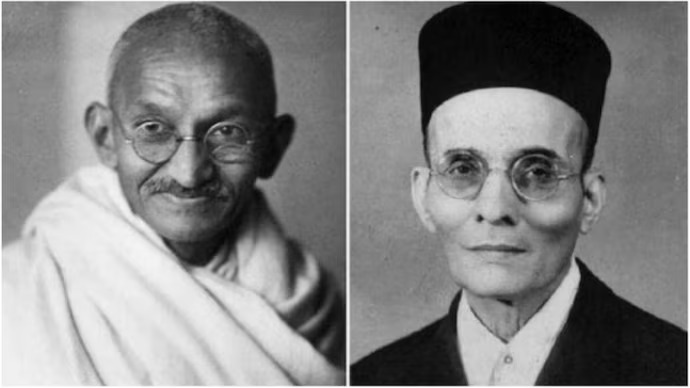
India’s cow politics did not begin with television debates, lynching headlines or election speeches. It began with a philosophical war between two men who imagined India in completely different ways.
One saw the cow as the moral centre of Indian civilization.
The other saw the worship of the cow as a symptom of civilizational weakness.
One called the cow a mother.
The other warned that turning a useful animal into a divine object would destroy the intellect of the nation.
Those two men were Mohandas Karamchand Gandhi and Vinayak Damodar Savarkar.
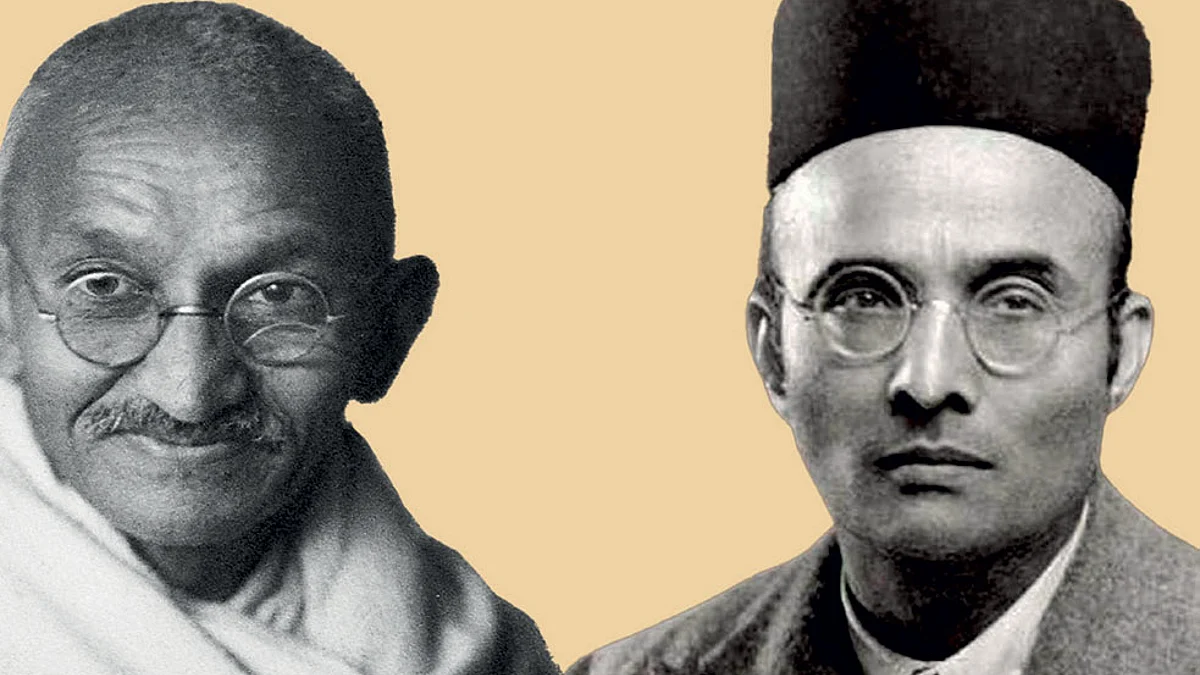
Modern India still argues between them.
And perhaps the strangest part of that argument is this: today’s political camps often end up defending the ideas of the very men they claim to oppose.
The Indian right politically worships Savarkar, yet on cow protection often sounds deeply Gandhian.
The Indian liberal and left intelligentsia emotionally celebrates Gandhi, yet on cow worship often sounds surprisingly Savarkarite.
India’s cow politics is therefore not just about religion, beef or identity. It is a century-old conflict between spirituality and rationalism, morality and power, symbolism and utility.
To understand the present, one must first return to the intellectual battlefield where Gandhi and Savarkar clashed over the meaning of the cow itself.
Gandhi’s India: the cow as civilization, morality and compassion
For Gandhi, the cow was never merely an animal.
It represented an ethical universe.
He viewed cow protection not simply as Hindu religious sentiment, but as a moral test of civilization itself.
In one of his most famous statements, Gandhi wrote:
“Cow protection to me is one of the most wonderful phenomena in human evolution.”
Elsewhere, he described the cow as:
Cow is the source of progress and prosperity. In many ways it is superior to one’s mother.
“When I see a cow, it is not an animal to eat, it is a poem of pity for me and I worship it and I shall defend its worship against the whole world.”
Gandhi’s emotional language about cows often shocks modern secular readers, especially younger Indians unfamiliar with the deeply spiritual vocabulary of the freedom movement.
But Gandhi’s position was tied to something larger than ritual.
He believed India’s civilization rested upon nonviolence, restraint and compassion toward weaker beings.
The cow became a symbol of that compassion.
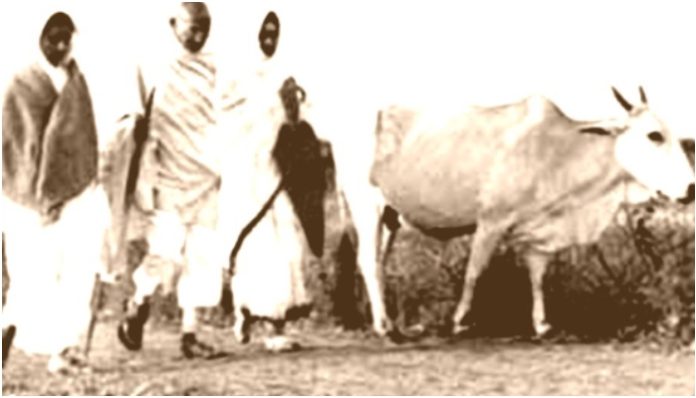
In Gandhi’s imagination, India was fundamentally rural. Villages, spinning wheels, cattle, agriculture and self-sufficient local economies formed the foundation of his political philosophy.
The cow therefore represented not just religion, but economic survival.
Milk, farming, manure and cattle labour were essential to village life in pre-industrial India.
Yet Gandhi’s language frequently moved beyond economics into sacred emotion.
One of the most controversial statements attributed to Gandhi argued that the cow was superior even to one’s biological mother because the cow continuously served humanity without expectation.
To many modern Indians, especially rationalists, such statements sound excessive.
But Gandhi was speaking from a civilizational framework where morality and spirituality were inseparable from politics.
He believed nations survive not through force alone, but through ethical discipline.
And in Gandhi’s ethical imagination, reverence for the cow symbolized reverence for life itself.
Yet Gandhi’s position is often misunderstood today.
Although he strongly defended cow protection, he opposed violence in its name.
Repeatedly, Gandhi condemned hatred and coercion carried out over cow slaughter.
In Young India, he famously wrote:
“I would not kill a human being for protection of a cow, as I will not kill a cow for saving a human life, be it ever so precious.
This distinction matters enormously.
Modern cow vigilantism is often justified using language of cultural protection. But Gandhi’s cow politics was rooted in persuasion, sacrifice and moral appeal, not mob violence.
He wanted Indians to emotionally respect the cow.
He did not want Indians to attack one another over it.
Savarkar’s rebellion against sacred cows
If Gandhi spiritualized the cow, Savarkar attempted to desacralize it.
Savarkar’s criticism of cow worship was not hidden, subtle or hesitant.
It was direct.
Sometimes brutally direct.
In speech after speech, Savarkar attacked what he saw as blind superstition surrounding the cow.
For him, excessive reverence toward cattle represented emotional irrationality masquerading as religion.
He repeatedly argued that a useful animal had been transformed into an untouchable sacred object, and in the process, society had weakened itself intellectually.
One statement associated with Savarkar sharply captured this worldview:
“The blind superstitions surrounding the worship of cows will completely destroy the intellect of the nation. Cow is a useful animal but not your mother.”
This was not merely criticism of religion.
It was criticism of civilizational psychology itself.
Savarkar believed that societies obsessed with symbolism become politically weak.
Where Gandhi saw compassion, Savarkar saw passivity.
Where Gandhi saw morality, Savarkar saw emotionalism.
Where Gandhi saw sacred civilization, Savarkar saw intellectual stagnation.
At times, Savarkar deliberately used provocative language to attack ritualism.
In another statement attributed to him, he mocked the theological imagination surrounding the cow:
“Considering the cow divine, mother and God and understanding it above humans is an insult to humanity.”
Elsewhere, he criticized the belief that millions of deities resided symbolically inside the body of the cow:
“Your blasphemy is far, far bigger. Just see how you’ve crammed 33 crore deities into a cow’s belly.”
Savarkar’s language was confrontational because he believed confrontation was necessary.
To him, sentimentality had weakened Hindu society historically.
He did not reject the usefulness of cows.
He rejected their deification.
That distinction defined his politics.
Savarkar’s most provocative question: “Why not pig-protection groups too?”
Among Savarkar’s sharpest criticisms of cow worship was his attack on what he considered selective religious logic.
In one particularly provocative argument, Savarkar pointed toward Hindu mythology itself.
He argued that if Hindu scriptures could celebrate Vishnu’s Varaha avatar, the boar incarnation of Vishnu, then treating the pig as impure while treating the cow as uniquely sacred exposed a contradiction within religious society.
One quote attributed to Savarkar captures this attack directly:
“If Hindu Puranas have talked about a cow, they also have talked about pigs in the form of Lord Vishnu’s Varaha Avatar. Then why not set up pig-protection groups on the lines of Gau Rakshaks?”
The statement was deliberately confrontational.
Savarkar was not merely mocking ritualism. He was attempting to expose what he believed was selective emotional morality operating inside society.
Why should one animal become sacred while another animal associated with divinity in mythology remains socially impure?
Why should religion produce hierarchy among animals at all?
For Gandhi, such questions missed the emotional and civilizational meaning attached to the cow within Indian society.
For Savarkar, however, these emotional attachments represented intellectual inconsistency.
This became one of the deepest differences between the two men.
Gandhi believed civilization survives through sacred moral symbols.
Savarkar believed civilization weakens when symbols replace rational thinking.
That disagreement still echoes in modern India.
Even today, debates around cow politics often move between these two poles:
- emotional reverence
- rational criticism
And nearly every modern political ideology in India unconsciously borrows from one of these two traditions.
“If the nation must be built around an animal, let it be the lion”
Perhaps the clearest contrast between Gandhi and Savarkar emerged in how both men imagined the spirit of the nation itself.
Gandhi’s politics celebrated humility, restraint and moral endurance.
Savarkar admired strength, aggression and strategic realism.
One quote associated with Savarkar captures this contrast dramatically:
“Considering the cow to be divine and worshipping her, the entire nation became docile like the cow. It started eating grass. If we are to now found our nation on the basis of an animal, let that animal be the lion.”
This was not simply metaphorical rhetoric.
It revealed how differently the two men imagined national character.
Gandhi believed moral courage was stronger than violence.
Savarkar believed civilizations without hardness eventually collapse.
The cow therefore became symbolic of two competing ideas of India.
Gandhi’s India was spiritual.
Savarkar’s India was political.
Gandhi wanted India to be morally admired.
Savarkar wanted India to be strategically feared.
Both were nationalists.
But they defined national strength differently.
The rationalist inside Savarkar
Modern political portrayals of Savarkar often reduce him entirely to Hindu nationalism.
But his writings on caste, superstition and ritual reveal another side: Savarkar the rationalist critic.
Several of his remarks sharply attacked caste hypocrisy and ritual purity.
One statement associated with him reads:
“So called upper caste Hindus who won’t mind drinking cow urine and consuming cow dung but at the same time refuse to accept a glass of water from the hands of the supremely intellectual Ambedkar.”
In another line, he questioned ritual purity itself:
“Why is cow’s urine and dung considered purifying, while even being in the shadow of a man like Ambedkar is deemed defiling?”
Savarkar believed this contradiction exposed what he called the destruction of intellect within society.
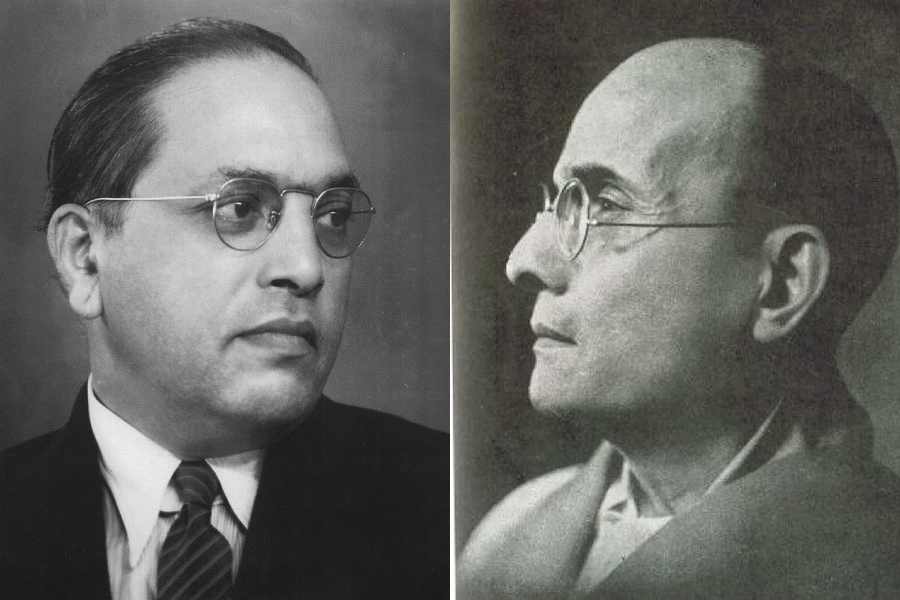
These arguments placed him closer to social reformers and rationalists than many modern supporters acknowledge.
Ironically, many liberal critics who reject Savarkar politically often unknowingly echo his arguments when criticizing superstition or cow-based purity politics.
Gandhi, Muslims and the limits of cow protection
The modern political image of Gandhi as merely a soft secular figure also misses important historical complexity.
Gandhi openly defended cow protection throughout his life.
He emotionally opposed cow slaughter.
He believed the cow held a sacred place within Hindu civilization.
But he also argued that Hindu-Muslim harmony mattered deeply.
He refused to support coercion against Muslims over cattle slaughter.
This put Gandhi in a difficult political position.
To orthodox cow protection activists, Gandhi sometimes appeared too conciliatory.
To secular critics, he often appeared too religious.
That tension still defines Indian politics today.
Many modern political groups selectively quote Gandhi’s spirituality while ignoring his rejection of violence.
Others celebrate Gandhi’s secularism while avoiding his deep attachment to Hindu symbolism.
The real Gandhi was far more complicated than either side admits.
The irony of modern Indian politics
This is where the story becomes deeply ironic.
Today, many Hindu nationalist organizations strongly support aggressive cow protection laws, emotional cow symbolism and political mobilization around Gau Raksha.
Yet much of this emotional framework resembles Gandhi more than Savarkar.
Savarkar repeatedly warned against blind cow worship.
He criticized superstition.
He attacked emotional excess.
He rejected turning religion into irrational sentiment.
Meanwhile, many liberals and leftists criticize sacred cow politics, reject religious emotionalism in governance and defend rationalism over mythology.
Yet these arguments often resemble Savarkar’s own critique.
Modern India therefore lives inside an ideological inversion.
The political right reveres Savarkar while emotionally sounding Gandhian on cows.
The political left reveres Gandhi while intellectually sounding Savarkarite on cows.
This contradiction exposes how poorly modern political labels explain India’s intellectual history.
Was Gandhi “left wing”? Was Savarkar “right wing”?
Applying modern categories to pre-independence India creates confusion.
Gandhi opposed industrial capitalism in many forms, defended decentralized economics and criticized material greed.
Many modern scholars describe aspects of Gandhi’s economics as socialist or anti-capitalist.
At the same time, Gandhi remained deeply religious and culturally conservative.
Savarkar, meanwhile, criticized superstition, supported scientific thinking and attacked ritual orthodoxy, yet politically developed the foundations of Hindu nationalism.
Neither man comfortably fits modern left-right categories.
That is precisely why their debate remains alive.
India never fully became Gandhi’s India.
Nor did it fully become Savarkar’s India.
Instead, modern India absorbed fragments of both.
Cow politics after independence: from moral symbolism to electoral weapon
After independence, the cow slowly transformed from a spiritual and philosophical symbol into an electoral instrument.
Political parties increasingly discovered that the cow could mobilize identity, emotion and polarization.
The issue evolved beyond religion.
It became:
- a caste question
- an economic question
- a communal question
- a constitutional question
- a rural livelihood question
- a political weapon
Over decades, the original philosophical debate between Gandhi and Savarkar became simplified into slogans.
Nuance disappeared.
Television debates replaced ideological depth.
Historical complexity gave way to political branding.
Yet beneath modern noise, the old argument still survives.
Should the cow be respected spiritually?
Or treated rationally?
Should culture guide politics?
Or should politics rise above sacred sentiment?
India still has not answered these questions.
The unfinished argument between Gandhi and Savarkar
The debate over the cow was never really about cattle.
It was about the soul of India.
Gandhi believed civilization survives through compassion.
Savarkar believed civilization survives through strength and intellect.
Gandhi feared moral collapse.
Savarkar feared intellectual collapse.
Gandhi tried to spiritualize politics.
Savarkar tried to rationalize nationalism.
And somewhere between those two visions stands modern India: emotional, contradictory, religious, rational, wounded, democratic and perpetually divided against itself.
Nearly a century later, Gandhi and Savarkar are still arguing.
Not in speeches.
Not in books.
But through political parties, television studios, university debates, WhatsApp forwards, lynching headlines, rationalist movements and election campaigns.
The cow remains at the centre of that argument.
Not because India is obsessed with an animal.
But because India is still trying to decide what kind of civilization it wants to be.
The Hidden Truth Behind India’s Cow Protection Politics: Why the Dairy Economy Makes a Total Ban Impossible Read here.
Support Independent Journalism
If you like our work and value deep, honest, and unfiltered reporting like this, consider supporting us. Your contribution helps us continue independent journalism.