


When an Ancient Epic Entered a Modern Courtroom
A YouTube video uploaded by political commentator Dhruv Rathee has reopened one of the oldest debates in Indian history.
Within days, what began as a discussion on ancient texts evolved into a legal battle, a political controversy, and a nationwide argument over religion, history, food, and identity.
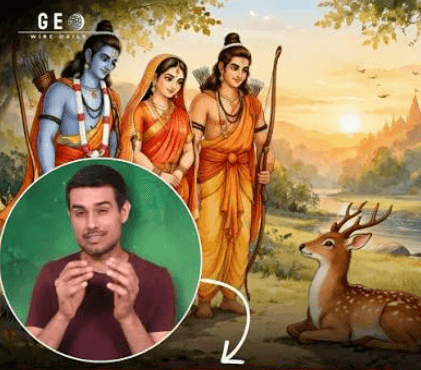
At the center of the controversy was Rathee’s video discussing whether figures such as Ram and Sita consumed meat during their exile, citing passages from the Valmiki Ramayana. Critics accused him of distorting Hindu scriptures and hurting religious sentiments. A legal complaint followed, eventually reaching the Delhi High Court.
The court itself did not decide whether the historical claims in the video were true or false. Instead, it directed the government’s Grievance Appellate Committee to decide the pending appeal regarding the complaint within a fixed time frame. That distinction is important.
The court was dealing with a legal process.
The internet was arguing about history.
Those are not the same thing.
Yet the controversy exposed something much larger than one YouTube video.
It revealed how modern India continues to struggle with questions that have existed for centuries.
Can ancient religious texts be discussed historically?
Can different interpretations coexist with religious belief?
And perhaps the biggest question of all.
Has India forgotten how diverse its own civilization has always been?
The Video That Sparked The Debate
Rathee’s video attempted to examine food habits described in ancient Indian literature. Among other things, it discussed passages from the Valmiki Ramayana that have been interpreted by some scholars as references to hunting and meat consumption during Rama’s exile.
Supporters argued that he was discussing the oldest available Sanskrit text and presenting one scholarly interpretation.
Critics argued that he selectively quoted verses, ignored devotional traditions, and presented contested interpretations as settled facts.
Soon the discussion moved beyond YouTube.
Petitions were filed.
Television debates began.
Social media divided into predictable camps.
One side declared that history was finally being discussed honestly.
The other insisted that sacred figures had been deliberately misrepresented.
The argument quickly became political.
But long before it became political, it was already a historical debate.
Why The Valmiki Ramayana Matters
One of the biggest misunderstandings in public discussions is that there is only one Ramayana.
There is not.
India has preserved numerous Ramayana traditions over many centuries.
Among them, the Valmiki Ramayana is generally regarded as the oldest surviving Sanskrit version and forms the basis for much historical discussion.
Later came many other retellings.
Tulsidas wrote the Ramcharitmanas.
Kamban composed the Kamba Ramayanam in Tamil.
There are Jain Ramayanas.
Buddhist Ramayanas.
Regional folk Ramayanas.
Versions across Southeast Asia.
Each reflects different cultural and religious traditions.
Because these texts were composed in different periods and for different audiences, they do not always emphasize the same details.
That is why historians often distinguish between discussing the Valmiki Ramayana as an ancient literary source and discussing later devotional traditions that shaped popular Hindu practice.
These are related traditions, but they are not identical.
What Is Actually Being Debated?
The controversy is not simply about whether one sentence exists inside an ancient text.
It is about interpretation.
Some scholars point to passages describing Rama hunting deer and other animals during exile and argue that these references indicate meat consumption.
Others argue that such passages have been misunderstood, mistranslated, taken out of context, or interpreted too literally.
Some commentators distinguish between hunting and eating.
Others argue that later devotional traditions intentionally presented Rama as an ideal vegetarian king, reflecting changing religious values over time.
This is precisely why historians rarely describe the issue as settled.
Ancient texts often require interpretation.
Language changes.
Context changes.
Commentaries differ.
Translations differ.
Religious traditions evolve.
History is rarely as simple as a viral social media post.
Ancient India Never Had One Single Food Culture
Perhaps the biggest assumption exposed by this controversy is the belief that India has always followed one uniform food culture.
Historical evidence suggests otherwise.
India is not one food tradition.
It is hundreds of food traditions.
Travel from Kashmir to Kerala.
From Gujarat to Assam.
From Konkan to Bengal.
Languages change.
Dialects change.
Climate changes.
Agriculture changes.
Even religious practices often change.
Food changes with them.
What is considered ordinary in one region may be completely unfamiliar in another.
That diversity existed long before modern India.
It still exists today.
And it is one of the defining characteristics of Indian civilization.
Did Lord Ram Eat Meat? The Dhruv Rathee Controversy, the Valmiki Ramayana, and India’s Forgotten Food Diversity
Part 2 | Analysis
Suggested Image:
A collage showing Jagannath Temple, Dakshineswar Kali Temple, a Kerala temple festival, Konkan fish cuisine, and a vegetarian thali from North India.
India Never Developed One Uniform Hindu Food Culture
One of the biggest mistakes people make while discussing this controversy is assuming there has always been a single “Hindu food culture.”
History tells a far more complicated story.
India is not a civilization built around one language.
It is not built around one ethnicity.
It is not built around one cuisine.
It is not even built around one version of the Ramayana.
The same diversity exists in food.
For thousands of years, geography shaped what people ate far more than modern political narratives.
Communities living in the Himalayas developed different diets from those living along India’s coastline.
Agricultural regions developed different food traditions from forest communities.
Fishing communities naturally depended on rivers and seas.
Pastoral communities depended on milk and livestock.
Food reflected local ecology before it reflected ideology.
That diversity still exists.
From Kashmir To Kerala, Food Changes Every Few Hundred Kilometres
Travel across India and the menu changes constantly.
In Kashmir, meat has historically been an important part of local cuisine among many communities.
Move towards Punjab, and dairy becomes central to everyday life.
Travel through Rajasthan, where water scarcity influenced food habits differently.
Reach Gujarat, where many communities developed strong vegetarian traditions.
Cross into Bengal, and fish becomes deeply embedded in regional culture.
In coastal Konkan, seafood has remained part of everyday life for generations.
Kerala developed one of the most diverse food cultures in India, combining rice, coconut, seafood, vegetables and meat depending on community and region.
The Northeast presents another entirely different culinary landscape.
These differences are not modern.
Most are centuries old.
To describe all Hindus as following one historical food tradition ignores the enormous diversity preserved across the subcontinent.
Temple Traditions Are Also More Diverse Than Many Assume
India’s temples also reflect regional diversity.
Many famous temples follow strictly vegetarian traditions.
Others have historically followed different local customs.

For example, some temples dedicated to Goddess Kali in parts of eastern India have long traditions of animal sacrifice, although practices vary widely from temple to temple and many temples do not perform them.
In several coastal regions, local traditions have incorporated fish or seafood into community festivals, though not necessarily as temple offerings.
Meanwhile, many Vaishnav temples maintain strict vegetarian practices and prohibit meat entirely.
These differences often developed through centuries of local customs rather than one uniform national tradition.
That does not make one tradition more “Hindu” than another.
It reflects the extraordinary regional diversity of Indian religious practice.
Vegetarianism Has Deep Roots. So Does Diversity.
Vegetarianism occupies an important place within Hindu philosophy.
Ideas such as ahimsa, particularly within several Hindu, Jain and Buddhist traditions, encouraged non-violence toward living beings.
Many Vaishnava traditions, numerous Brahmin communities, and countless Hindu families continue to observe vegetarian diets as an expression of faith.
That tradition deserves recognition.
At the same time, historians and anthropologists have documented that many Hindu communities across India have traditionally consumed fish or meat depending on geography, occupation and local customs.
Both realities have existed within Indian civilization.
Neither completely erases the other.
The problem begins when one regional practice is presented as the only historical reality for an entire civilization.
Why Ancient Texts Continue To Create Modern Political Storms
The debate surrounding Dhruv Rathee’s video is not only about food.
It is about identity.
Ancient epics are not merely literary works for millions of Indians.
They are sacred texts.
For believers, discussions about Ram are discussions about faith itself.
For historians, the same texts are also historical documents that can be studied, translated and interpreted.
Those two approaches do not always produce the same conclusions.
As a result, public debates often become emotionally charged.
One side fears history is being distorted.
The other fears history is being simplified.
Social media rarely rewards nuance.
Algorithms amplify outrage.
Television debates reduce centuries of scholarship into thirty-second arguments.
Complex historical questions become hashtags.
Interpretations become political identities.
The original discussion often disappears.
A Civilization Too Diverse For One Narrative
Perhaps the greatest lesson from this controversy is not about whether one ancient verse refers to meat.
It is about India’s remarkable diversity.
India contains dozens of major languages.
Hundreds of dialects.
Countless local traditions.
Different Ramayana traditions.
Different temple customs.
Different philosophies.
Different cuisines.
The attempt to reduce all of that diversity into one single historical narrative has always been difficult.
Sometimes impossible.
History is rarely simple.
Civilizations that survive for thousands of years rarely remain culturally identical.
India is no exception.
The Bigger Question
The controversy surrounding Dhruv Rathee’s video will eventually fade.
Court cases will conclude.
Headlines will change.
Social media will move on.
But the larger questions will remain.
How should modern India discuss ancient texts?
Can historical research and religious belief coexist without becoming political warfare?
Can different regional traditions exist without being dismissed as less authentic?
And perhaps the most important question of all.
Can a civilization as diverse as India accept that its own history has never been completely uniform?
Whether one agrees with Dhruv Rathee or not, the debate has exposed something much deeper than one YouTube video.
It has reminded the country that India’s greatest historical strength has never been uniformity.
It has always been diversity.
A civilization where languages change every few hundred kilometres.
Where cuisines change from one coast to another.
Where rituals differ from one temple to the next.
And where even the same epic can be understood through different traditions, commentaries and interpretations.
Understanding that diversity does not weaken Indian civilization.
It helps explain why it has endured for millennia.
6 Comments