

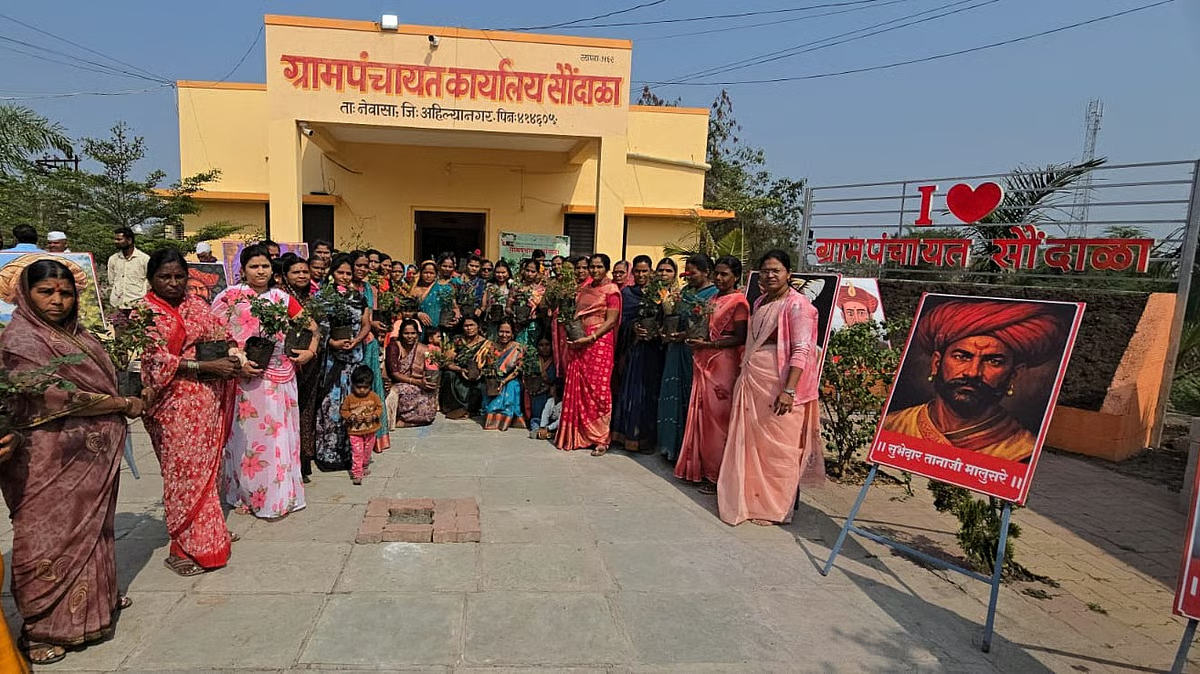
A Quiet Village Decision That Turned Into a National Question

In early 2026, a small and largely unknown village named Soundala, located in Maharashtra’s Ahilyanagar district, made a decision that most of India has debated for decades but never fully acted upon. In a Gram Sabha meeting, villagers came together and passed a resolution declaring their village “caste-free.” It was not a symbolic move designed for headlines or political attention. It was a decision that directly affects how people live with each other every single day.
The importance of this moment lies in its simplicity. There was no large campaign, no external pressure, and no national movement behind it. It was a local decision, taken by ordinary people, to change a system that has shaped Indian society for generations. That alone makes it unusual, because most conversations about caste in India happen at a distance, in courts, in politics, or in academic discussions. Soundala brought that conversation into daily life.
What It Actually Means to Remove Caste From Daily Life
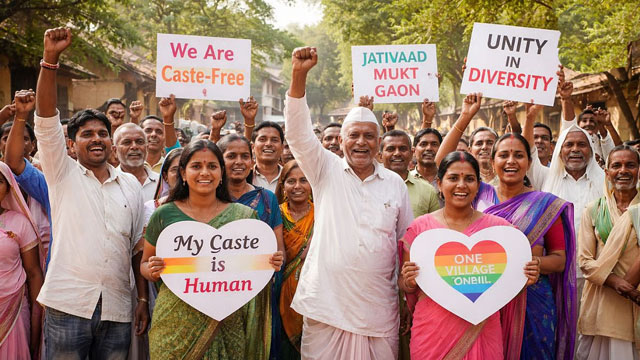

Declaring a village caste-free is easy to say, but difficult to understand unless it is broken down into real actions. In Soundala, the resolution is not just about avoiding certain words. It is about changing behavior at a basic level. The idea is that no person in the village will be treated differently because of the caste they were born into.
This means that public spaces like temples, water sources, cremation grounds, and schools are to be used equally by everyone, without any informal restrictions. It also means that social interactions, which were often guided by caste boundaries in the past, are now expected to happen without those divisions. Even small things, like how people address each other or who participates in community events, are part of this shift.
What makes this important is that caste in India often operates quietly. It is not always visible in laws, but it exists in habits, expectations, and unspoken rules. Soundala’s decision is an attempt to bring those invisible boundaries into the open and remove them.
The Slow Change Visible in Everyday Life

The real impact of this decision is not in the resolution itself but in how it changes daily life. In villages across India, caste has traditionally influenced who interacts with whom, where people sit, and how close different communities are to each other. These patterns do not disappear overnight, but in Soundala, there are visible signs of change.
People are beginning to interact more freely across earlier boundaries. Social visits between households are becoming more common. Community gatherings are slowly becoming more inclusive. Children, who often inherit social divisions without questioning them, are growing up in an environment where those divisions are less rigid.
This kind of change may appear small from the outside, but it is deeply significant. Social systems like caste survive through repetition. When daily behavior starts to shift, the system itself begins to weaken.
This Decision Did Not Come Out of Nowhere
Soundala’s declaration is not an isolated moment. It is the result of gradual changes in the village over time. Before this resolution, there had already been efforts to improve social conditions within the community. These included encouraging participation across different groups, addressing social issues, and promoting more equal interaction among residents.
Because of this background, the idea of becoming caste-free did not appear as a sudden or unrealistic demand. It felt like the next step in a process that had already begun. This is an important detail, because it shows that such decisions are not created instantly. They are built over time through smaller changes in thinking and behavior.
Why This Story Matters Beyond One Village

It would be easy to treat this as a positive local story and move on. But that would miss the larger point. Soundala’s decision matters because it directly challenges the idea that caste is too deeply rooted to be changed at the ground level.
Across India, caste continues to influence major aspects of life. It affects marriage decisions, social acceptance, and even professional opportunities. In many cases, it also plays a role in politics, where identities are often used to mobilize support.
Soundala does not solve these issues. But it shows that change is not impossible. It removes a common argument, that people are not ready for such a shift. Clearly, in at least one village, they are.
The Larger Contrast With the Rest of India
The reality outside Soundala remains complex. In many parts of the country, caste is still an active force in both social and political life. It shapes alliances, influences leadership decisions, and continues to define how communities organize themselves.
There is also a gap between public messaging and actual practice. Equality is widely accepted as an idea. But in practice, many systems continue to operate within caste-based structures. This contradiction is rarely addressed directly, but it is widely understood.
Soundala’s decision brings this contradiction into focus. It asks a simple question: if a small village can take this step, why is it so difficult at larger levels?
Why Some Regions Moved Ahead in Social Reform


The progress seen in states like Maharashtra, Tamil Nadu, Kerala, Karnataka, and West Bengal is often linked to a long history of social reform movements. These regions were shaped by thinkers and leaders who challenged inequality directly and worked to change how society functioned.
Their influence was not limited to speeches or writings. It reached people at the ground level, through education, awareness, and public engagement. Over time, this created an environment where questioning hierarchy became more acceptable.
This does not mean these states are free from caste issues. But the presence of strong reform traditions has made it easier for ideas of equality to take root. Soundala’s decision can be seen as part of this broader historical influence.
What Soundala’s Experiment Means Going Forward
Soundala has not ended caste. That would be an unrealistic claim. What it has done is create a working example of what change can look like at the local level.
The real challenge will be maintaining this change over time. Social systems do not disappear easily, and there will be pressures, both internal and external, that test this decision. The next few years will determine whether this model can sustain itself.
At the same time, the village has already achieved something important. It has shown that change does not always need to come from the top. It can begin with a collective decision, supported by consistent action.
A Small Place, A Larger Question
Soundala’s story is not about perfection. It is about possibility.
At a time when caste continues to influence life across India, a small village has chosen to move in a different direction. It has done so quietly, without large-scale attention, but with clear intent.
That makes this more than just a local development. It turns into a larger question for the country.
If change can begin here, what is stopping it elsewhere?
For more such ground-level, unfiltered reporting, follow Unfiltered Indians.
Support Independent Journalism
If you like our work and value deep, honest, and unfiltered reporting like this, consider supporting us. Your contribution helps us continue independent journalism.

1 Comment