Home / Analysis /Maharashtra’s Political Earthquake: Are Regional Parties Being Replaced by a New Centralized Political Order?
Maharashtra’s Political Earthquake: Are Regional Parties Being Replaced by a New Centralized Political Order?
Indian democracy has always been unique. Unlike many countries where politics is dominated by two major parties, India’s political system has traditionally been shaped by strong regional parties. These regional parties emerged from local identities, languages, cultures, and state-specific concerns.
From Tamil Nadu to West Bengal, from Telangana to Maharashtra, regional parties have played a crucial role in representing local aspirations.
However, over the last decade, a major political transformation has been taking place.
Critics argue that India’s political landscape is becoming increasingly centralized, with regional parties losing power, influence, and even their own leaders. Supporters of this transformation argue that it represents political consolidation, stronger governance, and greater national unity.
The debate became particularly intense in Maharashtra after the dramatic splits in Shiv Sena and the Nationalist Congress Party (NCP).
This is the context in which journalist Rajdeep Sardesai made his controversial statement:
“A worst-kept secret is now coming out: if you want funds for your constituency, you now have to be on the right side of the party in power.”
His statement triggered a wider discussion about democracy, political funding, defections, and the future of regional politics in India.
The important question is:
Is Maharashtra witnessing a normal political realignment, or is it becoming an example of how regional parties can be weakened and absorbed into a larger political structure?
Maharashtra: The Stronghold of Regional Politics
For decades Maharashtra had one of India’s most vibrant political ecosystems.
Unlike states dominated by a single national party, Maharashtra was shaped by powerful regional movements.
Shiv Sena
Founded by Bal Thackeray in 1966, Shiv Sena emerged as a movement focused on Marathi identity and regional pride.
The party positioned itself as the defender of Maharashtrian interests.
Over time it became one of the most influential political forces in the state.
Nationalist Congress Party (NCP)
Founded by Sharad Pawar in 1999, the NCP became another major regional force.
Sharad Pawar was widely seen as one of India’s most influential regional leaders.
The NCP built strong support among farmers, cooperative institutions, and rural communities.
The Traditional Balance
For many years Maharashtra politics revolved around:
Congress
NCP
Shiv Sena
BJP
Each party had its own support base.
No single party could dominate the state completely.
Coalition politics became normal.
This balance allowed regional voices to remain influential.
The Rise of BJP in Maharashtra
The BJP was historically a junior partner to Shiv Sena in Maharashtra.
For decades Shiv Sena was considered the larger force.
However, this changed after 2014.
The BJP’s national rise under Prime Minister Narendra Modi transformed political dynamics across India.
The party expanded aggressively into states where regional parties had traditionally been dominant.
Maharashtra became one of the most important battlegrounds.
The BJP steadily increased its vote share, organizational strength, and political influence.
Many observers began noticing a pattern seen elsewhere in India:
Instead of simply defeating opponents electorally, the BJP often benefited from internal divisions within rival parties.
Supporters viewed this as smart political strategy.
Critics viewed it as a method of weakening regional forces.
The Shiv Sena Split
The biggest shock came in 2022.
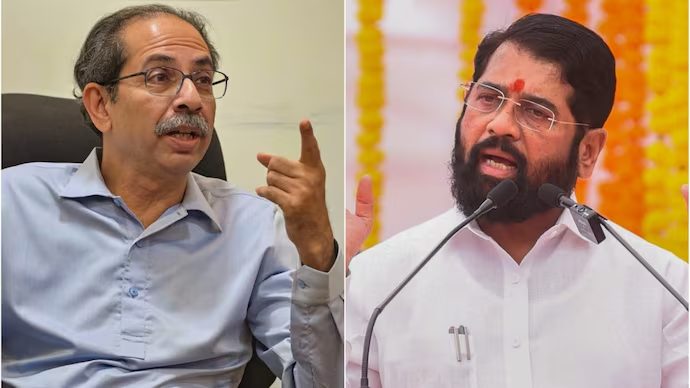
Eknath Shinde led a rebellion against Uddhav Thackeray’s leadership.
A large number of Shiv Sena MLAs joined Shinde.
The rebellion eventually led to the collapse of the Maha Vikas Aghadi government.
The political consequences were enormous.
For the first time in its history, Shiv Sena was effectively divided into two factions.
The Uddhav Thackeray Position
Uddhav Thackeray and his supporters argued that the original Shiv Sena had been taken away from them.
They claimed the rebellion was encouraged and supported by forces outside the party.
According to them, voters had elected Shiv Sena representatives under one leadership and ideology.
Therefore, the split represented a betrayal of the public mandate.
The Shinde Position
Eknath Shinde and his supporters rejected these accusations.
They argued that they represented the true ideology of Bal Thackeray.
According to them, Uddhav Thackeray had moved away from the party’s original principles.
They claimed their rebellion was an ideological correction rather than a political betrayal.
The NCP Split
Before Maharashtra could recover from the Shiv Sena split, another political earthquake occurred.
Ajit Pawar and several NCP leaders broke away from Sharad Pawar’s leadership.
The move created another division in Maharashtra’s political landscape.
For decades Sharad Pawar had been one of the state’s most influential leaders.
Now his party was also divided.
The timing of the split led critics to ask difficult questions.
Why were so many regional parties experiencing internal fractures?
Why were these fractures often benefiting the ruling alliance?
Supporters of the government argued that political leaders were simply making independent decisions.
Critics argued that a broader pattern was emerging.
The Funding Controversy
This is where Rajdeep Sardesai’s statement becomes important.
The controversy revolves around development funds.
Development funds are public resources intended to improve infrastructure, roads, schools, hospitals, and local services.
In theory, these funds belong to taxpayers.
They are not meant to reward political loyalty.
Critics claim that constituencies represented by ruling alliance legislators often receive greater access to resources.
According to this argument, opposition representatives may find it harder to secure funding for projects.
If true, this creates a significant democratic concern.
Citizens do not stop being taxpayers simply because they voted for an opposition candidate.
Development should ideally be based on public need rather than political affiliation.
This is the core argument behind Rajdeep Sardesai’s statement.
He argues that when development funds become linked to political loyalty, democracy itself begins to suffer.
Why Many Critics Agree With Rajdeep Sardesai
There are several reasons why critics find his argument convincing.
1. Taxpayer Money Belongs to Everyone
Government funds are collected from citizens regardless of political affiliation.
A voter supporting one party pays the same taxes as a voter supporting another.
Therefore many believe development funds should be distributed fairly across constituencies.
2. Opposition Representation Matters
Democracy requires both government and opposition.
If opposition constituencies are disadvantaged, voters may feel pressured to support the ruling party simply to secure development.
Critics argue that this weakens democratic competition.
3. The Appearance of Pressure
Even if discrimination is difficult to prove legally, perceptions matter.
If politicians believe joining the ruling alliance improves access to resources, political incentives become distorted.
This can encourage defections.
4. Regional Voices Become Weaker
Regional parties often represent local concerns.
If these parties lose leaders through repeated defections, local political identities may gradually weaken.
Many observers fear that this could reduce political diversity.
The Counterargument
Supporters of the BJP strongly reject these accusations.
They present several arguments.
Governance Efficiency
They argue that stronger political alignment improves coordination between state and central governments.
Projects move faster when governments work together.
Democratic Choice
They argue that elected representatives have the right to change political positions.
Defections may reflect genuine disagreements rather than external pressure.
Electoral Success
Supporters also note that BJP’s growth is ultimately based on voter support.
They argue that the party wins elections because citizens choose it at the ballot box.
Lack of Legal Proof
Courts have not universally accepted claims of systematic discrimination in funding.
Supporters therefore argue that accusations often remain political rather than factual.


Maharashtra’s Political Earthquake: Are Regional Parties Being Replaced by a New Centralized Political Order?
Indian democracy has always been unique. Unlike many countries where politics is dominated by two major parties, India’s political system has traditionally been shaped by strong regional parties. These regional parties emerged from local identities, languages, cultures, and state-specific concerns.
From Tamil Nadu to West Bengal, from Telangana to Maharashtra, regional parties have played a crucial role in representing local aspirations.
However, over the last decade, a major political transformation has been taking place.
Critics argue that India’s political landscape is becoming increasingly centralized, with regional parties losing power, influence, and even their own leaders. Supporters of this transformation argue that it represents political consolidation, stronger governance, and greater national unity.
The debate became particularly intense in Maharashtra after the dramatic splits in Shiv Sena and the Nationalist Congress Party (NCP).
This is the context in which journalist Rajdeep Sardesai made his controversial statement:
“A worst-kept secret is now coming out: if you want funds for your constituency, you now have to be on the right side of the party in power.”
His statement triggered a wider discussion about democracy, political funding, defections, and the future of regional politics in India.
The important question is:
Is Maharashtra witnessing a normal political realignment, or is it becoming an example of how regional parties can be weakened and absorbed into a larger political structure?
Maharashtra: The Stronghold of Regional Politics
For decades Maharashtra had one of India’s most vibrant political ecosystems.
Unlike states dominated by a single national party, Maharashtra was shaped by powerful regional movements.
Shiv Sena
Founded by Bal Thackeray in 1966, Shiv Sena emerged as a movement focused on Marathi identity and regional pride.
The party positioned itself as the defender of Maharashtrian interests.
Over time it became one of the most influential political forces in the state.
Nationalist Congress Party (NCP)
Founded by Sharad Pawar in 1999, the NCP became another major regional force.
Sharad Pawar was widely seen as one of India’s most influential regional leaders.
The NCP built strong support among farmers, cooperative institutions, and rural communities.
The Traditional Balance
For many years Maharashtra politics revolved around:
Each party had its own support base.
No single party could dominate the state completely.
Coalition politics became normal.
This balance allowed regional voices to remain influential.
The Rise of BJP in Maharashtra
The BJP was historically a junior partner to Shiv Sena in Maharashtra.
For decades Shiv Sena was considered the larger force.
However, this changed after 2014.
The BJP’s national rise under Prime Minister Narendra Modi transformed political dynamics across India.
The party expanded aggressively into states where regional parties had traditionally been dominant.
Maharashtra became one of the most important battlegrounds.
The BJP steadily increased its vote share, organizational strength, and political influence.
Many observers began noticing a pattern seen elsewhere in India:
Instead of simply defeating opponents electorally, the BJP often benefited from internal divisions within rival parties.
Supporters viewed this as smart political strategy.
Critics viewed it as a method of weakening regional forces.
The Shiv Sena Split
The biggest shock came in 2022.
Eknath Shinde led a rebellion against Uddhav Thackeray’s leadership.
A large number of Shiv Sena MLAs joined Shinde.
The rebellion eventually led to the collapse of the Maha Vikas Aghadi government.
The political consequences were enormous.
For the first time in its history, Shiv Sena was effectively divided into two factions.
The Uddhav Thackeray Position
Uddhav Thackeray and his supporters argued that the original Shiv Sena had been taken away from them.
They claimed the rebellion was encouraged and supported by forces outside the party.
According to them, voters had elected Shiv Sena representatives under one leadership and ideology.
Therefore, the split represented a betrayal of the public mandate.
The Shinde Position
Eknath Shinde and his supporters rejected these accusations.
They argued that they represented the true ideology of Bal Thackeray.
According to them, Uddhav Thackeray had moved away from the party’s original principles.
They claimed their rebellion was an ideological correction rather than a political betrayal.
The NCP Split
Before Maharashtra could recover from the Shiv Sena split, another political earthquake occurred.
Ajit Pawar and several NCP leaders broke away from Sharad Pawar’s leadership.
The move created another division in Maharashtra’s political landscape.
For decades Sharad Pawar had been one of the state’s most influential leaders.
Now his party was also divided.
The timing of the split led critics to ask difficult questions.
Why were so many regional parties experiencing internal fractures?
Why were these fractures often benefiting the ruling alliance?
Supporters of the government argued that political leaders were simply making independent decisions.
Critics argued that a broader pattern was emerging.
The Funding Controversy
This is where Rajdeep Sardesai’s statement becomes important.
The controversy revolves around development funds.
Development funds are public resources intended to improve infrastructure, roads, schools, hospitals, and local services.
In theory, these funds belong to taxpayers.
They are not meant to reward political loyalty.
Critics claim that constituencies represented by ruling alliance legislators often receive greater access to resources.
According to this argument, opposition representatives may find it harder to secure funding for projects.
If true, this creates a significant democratic concern.
Citizens do not stop being taxpayers simply because they voted for an opposition candidate.
Development should ideally be based on public need rather than political affiliation.
This is the core argument behind Rajdeep Sardesai’s statement.
He argues that when development funds become linked to political loyalty, democracy itself begins to suffer.
Why Many Critics Agree With Rajdeep Sardesai
There are several reasons why critics find his argument convincing.
1. Taxpayer Money Belongs to Everyone
Government funds are collected from citizens regardless of political affiliation.
A voter supporting one party pays the same taxes as a voter supporting another.
Therefore many believe development funds should be distributed fairly across constituencies.
2. Opposition Representation Matters
Democracy requires both government and opposition.
If opposition constituencies are disadvantaged, voters may feel pressured to support the ruling party simply to secure development.
Critics argue that this weakens democratic competition.
3. The Appearance of Pressure
Even if discrimination is difficult to prove legally, perceptions matter.
If politicians believe joining the ruling alliance improves access to resources, political incentives become distorted.
This can encourage defections.
4. Regional Voices Become Weaker
Regional parties often represent local concerns.
If these parties lose leaders through repeated defections, local political identities may gradually weaken.
Many observers fear that this could reduce political diversity.
The Counterargument
Supporters of the BJP strongly reject these accusations.
They present several arguments.
Governance Efficiency
They argue that stronger political alignment improves coordination between state and central governments.
Projects move faster when governments work together.
Democratic Choice
They argue that elected representatives have the right to change political positions.
Defections may reflect genuine disagreements rather than external pressure.
Electoral Success
Supporters also note that BJP’s growth is ultimately based on voter support.
They argue that the party wins elections because citizens choose it at the ballot box.
Lack of Legal Proof
Courts have not universally accepted claims of systematic discrimination in funding.
Supporters therefore argue that accusations often remain political rather than factual.
You can share this post!
CM Vijay Temple Funds and Public Trust: Why Tamil Nadu’s ₹246 Crore Decision Matters
Sonam Wangchuk Announces Indefinite Hunger Strike, Puts Spotlight Back on India’s Education Crisis
Related Articles
Were India’s Student Protests Deliberately Divided? Examining the Narrative Around Jharkhand and…
Students Beaten After CJP Protest: The Rise of Political Street Influencers in…
Bihar Policeman Suspended After Allegedly Firing AK-47 During Student Protest