
A Debate Full of Noise, But Missing the Truth
India’s population debate has become loud, emotional, and often misleading. Every few months, social media fills with claims that one religion is growing faster, that one region is responsible, or that the country is heading toward a crisis. But when you step away from noise and look at real patterns, a very different story appears.
The truth is not simple, and it is definitely not about blaming one community. It is about understanding how education, healthcare, economy, and social awareness shape population trends over time. The difference between North and South India is real, but the reasons behind it are deeper than what most people are told.
This article explains everything in detail, step by step, in a way that connects facts, history, and present reality.
The Reality India Doesn’t Talk About: Population Growth Is Already Slowing
Before jumping into North vs South, one important fact must be clear. India is not in a population explosion phase anymore.
Over the last few decades, fertility rates across India have fallen sharply. Families today are having fewer children than before. This change did not happen suddenly. It happened slowly, through social and economic changes.
In simple terms, India is moving toward population stabilization. But this transition is not happening equally everywhere.
North vs South: The Divide That Shapes India’s Future

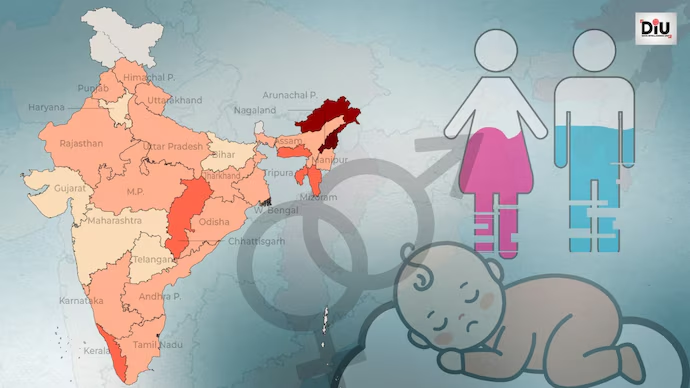
The biggest divide in India’s population story is not religion. It is geography.
Southern states like Kerala, Tamil Nadu, Karnataka, and Andhra Pradesh have already reached low fertility levels. Families are smaller, and population growth is slow or stable.
Northern states like Uttar Pradesh, Bihar, Rajasthan, and Madhya Pradesh still have higher fertility rates. Families are larger, and population continues to grow faster.
This is why most of India’s current population growth comes from a few northern states. It is not because people in the South are different. It is because the conditions in which people live are different.
How South India Achieved Population Stabilization


South India did not control population through strict rules or force. It changed naturally over time.
Education played a huge role. Female literacy improved early in southern states. When women are educated, they delay marriage, understand family planning, and choose to have fewer children.
Healthcare improved as well. Better hospitals and maternal care reduced child mortality. When parents are confident their children will survive, they do not feel the need to have more children.
Urbanization also changed behavior. City life is expensive. Raising children costs money, time, and effort. This naturally reduces family size.
Awareness programs about family planning worked better in southern states. People accepted them more openly.
All these factors together created a social shift. Population slowed down without any dramatic policy.
Why North India Still Has Higher Population Growth


Northern India did not fail in a simple way. It followed a slower path of development.
In many regions, education levels, especially for women, remained lower for a longer time. Healthcare access was uneven. Rural population remained high. Poverty levels affected decision making.
When families live in uncertainty, they tend to have more children. It becomes a form of social and economic security.
Also, a large young population already exists in northern states. Even if fertility rates start falling, total population continues to grow because there are more people in childbearing age.
This is called demographic momentum, and it explains why change takes time.
Religion and Population: The Most Misunderstood Topic


One of the most controversial parts of this debate is religion.
Yes, historically, Muslim fertility rates have been slightly higher than Hindu fertility rates. But this is only part of the story.
The bigger truth is this:
Fertility rates are falling in all communities.
The gap between different religions is shrinking over time. The difference is not permanent, and it is not the main driver of population growth.
When education, income, and healthcare improve, fertility drops across all groups, regardless of religion.
So the idea that population growth is driven mainly by religion is an oversimplification. It ignores the real factors that actually influence human behavior.
How Politics Turns Population Into a Narrative
Population is not just a social issue. It is also used as a political tool.
Different groups highlight different fears. Some warn about overpopulation. Others warn about declining population in certain communities. These narratives often contradict each other.
This confusion benefits political storytelling but does not help people understand reality.
When data is selectively used, it creates fear instead of awareness.
Migration: The Hidden Link Between North and South


Another important factor is migration.
Millions of workers from northern states move to southern states in search of jobs. This creates a strong economic link between regions.
North India supplies young workforce. South India provides jobs and opportunities.
This movement balances the economy, but it also highlights the gap between regions.
The Future Challenge: Ageing South and Young North


A new challenge is emerging.
Southern states are ageing faster because fewer children are being born. In the future, they may face shortage of working-age population.
Northern states still have a young population. This can be an advantage if jobs are created. But without opportunities, it can become a problem.
India’s future depends on how well this balance is managed.
The Core Truth: Development, Not Religion, Drives Population Change
When you connect all the facts, one conclusion becomes clear.
Population trends are shaped by:
- Education
- Women empowerment
- Healthcare access
- Economic stability
- Urbanization
Religion may show differences, but it is not the root cause.
Understanding Reality Instead of Following Narratives
The North vs South population debate is real, but it is often misunderstood.
South India’s success came from long-term investment in education, health, and social awareness.
North India is still transitioning, and change is happening, but slowly.
India is not facing uncontrolled population growth anymore. The real challenge now is creating jobs, reducing inequality, and preparing for future demographic changes.
If people continue to focus only on religion, they will miss the real issue.
And missing the real issue means missing the solution.
Support Independent Journalism
If you like our work and value deep, honest, and unfiltered reporting like this, consider supporting us. Your contribution helps us continue independent journalism.