
The Slow Unraveling of Bihar: From Civilizational Powerhouse to Development Lag


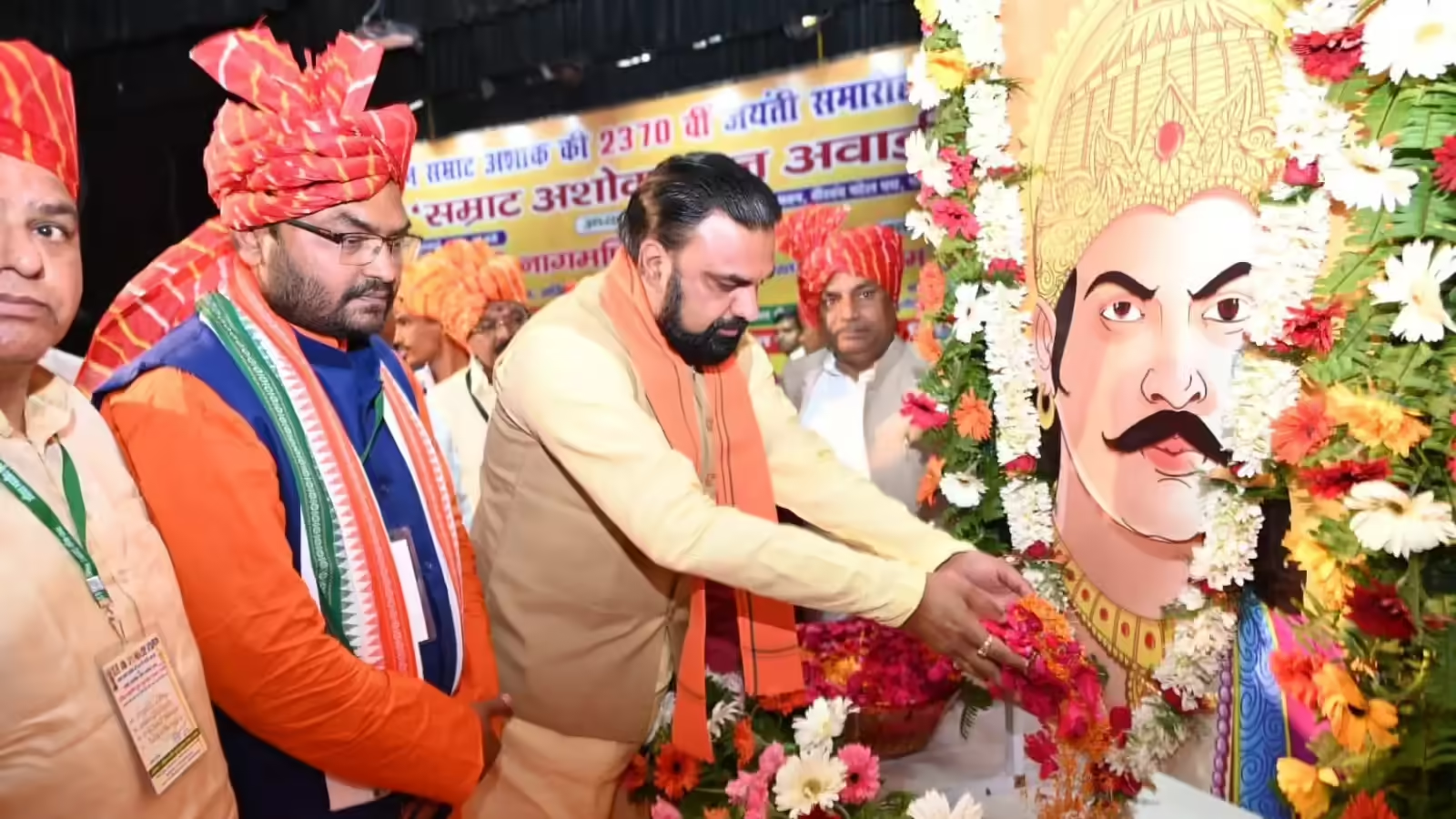
Bihar is not just another Indian state. It is a place that once defined governance, philosophy, and knowledge for an entire subcontinent. Under Ashoka, the region became the administrative and moral center of the Mauryan Empire. Cities like Patna, then known as Pataliputra, were global symbols of organized governance. Institutions such as Nalanda University attracted scholars from across Asia.
That legacy makes Bihar’s current condition not just disappointing but deeply puzzling. The question is not emotional. It is structural. How did a region that once led the world fall so far behind within a modern democratic system?
This article takes a critical look at that decline, inspired by public discourse including commentary similar to that of Mohan Manglani, while grounding the argument in broader socio-economic realities.
The Collapse of Governance Culture
Bihar’s decline cannot be explained without examining governance. Over decades, governance in the state has often shifted from long-term planning to short-term political survival.
Instead of focusing on institutional strength, policy continuity, and economic expansion, politics has frequently revolved around electoral arithmetic. Coalition shifts, unstable alignments, and constant political recalibration have weakened administrative consistency. When governance becomes reactive rather than strategic, development slows down.
The deeper issue is not just who governs, but how governance is practiced. Decision-making often prioritizes immediate political benefit over structural reform. This creates a system where visible announcements replace measurable outcomes.
The Economics of Vote Buying

One of the most controversial and widely discussed aspects of Bihar’s political culture is the alleged normalization of vote buying. Ground reports and election observers have repeatedly pointed out that sections of voters are influenced through direct or indirect monetary incentives.
The amounts vary, but the mechanism is consistent. Cash, goods, or immediate benefits are exchanged for political loyalty. This transforms elections into transactions.
The consequences are severe:
Democracy Becomes Transactional
When votes are purchased, accountability disappears. Leaders are not rewarded for performance but for their ability to mobilize money and influence.
Policy Becomes Secondary
Development policies lose importance. The focus shifts to maintaining networks of patronage rather than building infrastructure or improving services.
Poverty Gets Reinforced
Ironically, the same poverty that makes voters vulnerable to such incentives is perpetuated by the resulting poor governance. It becomes a closed loop.
Migration as a Survival Strategy
Bihar’s economy tells a clear story. The state has one of the lowest per capita incomes in India. Industrialization remains limited. Agriculture dominates employment but often without modernization or stability.
As a result, migration has become a defining feature of Bihari life.
Cities like Mumbai, Delhi, and Surat depend heavily on migrant labor from Bihar. For many families, migration is not a choice but a necessity.
This constant outflow has two major effects:
- It reduces local economic pressure but also weakens local development demand
- It normalizes the idea that success must be achieved outside the state
A region that exports its workforce at this scale struggles to build internal economic momentum.
Education: From Global Leadership to Systemic Weakness


Bihar once led the world in education. Today, its education system faces serious credibility issues.
While enrollment rates have improved, quality remains inconsistent. Problems include:
- Lack of trained teachers
- Weak accountability systems
- Infrastructure gaps in rural schools
- Examination irregularities and credibility concerns
Education is not just about access. It is about outcomes. Without quality education, economic transformation becomes nearly impossible.
Identity Politics Over Development
Caste and identity have always played a role in Indian politics, but in Bihar, they have often dominated electoral decision-making.
Voting patterns frequently align with caste blocs rather than policy performance. Political campaigns are designed around identity consolidation instead of development agendas.
This has three major consequences:
Fragmented Political Mandate
Leaders focus on specific groups instead of the entire population.
Reduced Accountability
Performance takes a back seat to identity loyalty.
Policy Distortion
Government schemes are sometimes shaped more by political calculations than actual need.
Weak Institutional Enforcement
Even when laws and policies exist, enforcement remains inconsistent.
Issues include:
- Slow judicial processes
- Limited administrative accountability
- Corruption at multiple levels
Without strong institutions, even well-designed policies fail in execution. Governance becomes symbolic rather than effective.
The Gap Between History and Reality


Modern political narratives often invoke Bihar’s ancient greatness. References to Ashoka, Nalanda, and historical pride are common.
But historical memory cannot replace present performance.
The gap between what Bihar was and what it is today highlights a deeper issue. Pride without progress creates stagnation. History should inspire reform, not replace it.
The Voter–Leader Feedback Loop
One of the most uncomfortable truths is that Bihar’s condition is shaped by both leadership and voter behavior.
- Politicians respond to incentives created by voters
- Voters respond to constraints created by economic conditions
This creates a feedback loop where:
- Short-term gains are prioritized
- Long-term development is ignored
- Structural change becomes difficult
Breaking this cycle requires change on both sides.
Conclusion: A Crisis of Systems, Not Potential
Bihar has not failed because it lacks resources or talent. It has failed because of systemic issues that reinforce each other:
- Transactional politics
- Weak governance structures
- Economic stagnation
- Poor education quality
- Identity-driven elections
The state’s history proves its capability. Its present reflects its challenges.
The real question is not whether Bihar can rise again. It is whether the systems that hold it back will be reformed.
Until then, the gap between its past glory and present reality will continue to define its story.